Avoiding Midair Collisions
Why Sky Scanning Is Essential
Fieldwork Foundations
Most midair collisions don’t happen in bad weather. They happen on clear, sunny days—when pilots feel relaxed, visibility feels infinite, and vigilance fades. That’s why sky scanning is part of your toolkit as a remote pilot.
The root cause of most avoidable collisions is human error. Proper scanning helps you spot trouble early and break the chain of events that lead to accidents.
How to Scan the Sky Effectively
5 Simple Steps
Fieldwork Foundations
Below is the FAA’s official guidelines on how to properly go about sky scanning during your flight missions. Whether you’re the Remote PIC or the Visual Observer, or even a member of the crew still supporting the crew resource management keeping everyone safe, this technique comes in handy.
Let’s take a look:
Step 1: Segment the Sky
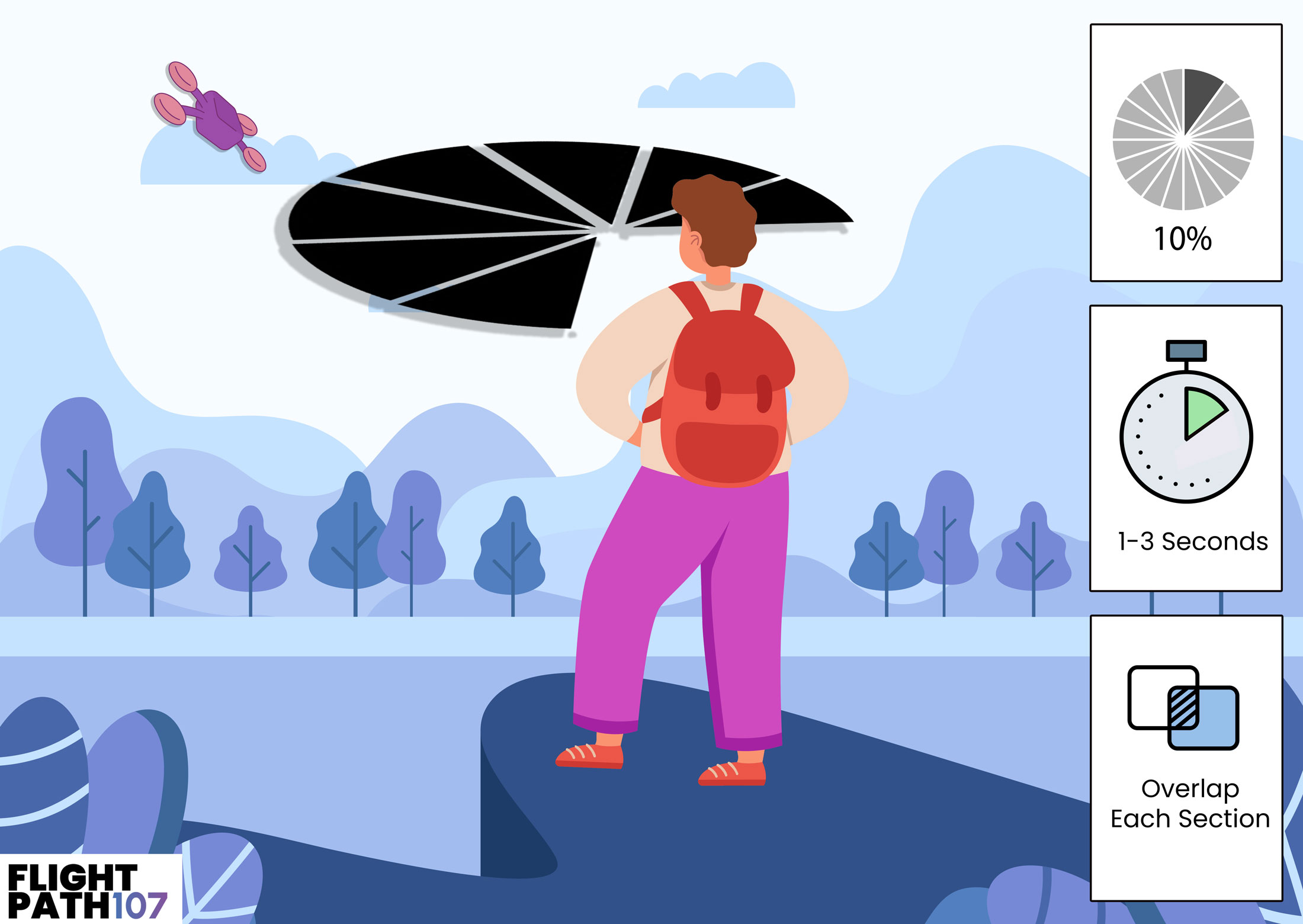
- Start by dividing the sky into smaller sections, each about 10 degrees wide.
- This makes scanning more manageable and helps reduce the chance of missing something.
Step 2: Scan Horizontally
- Scan your eyes horizontally across the sky, beginning from the furthest distance and moving inward.
- This structured approach aligns with natural eye movement and supports consistent coverage.
Step 3: Make Controlled Eye Movements
- Make sure to move your eyes in short bursts, focusing on one 10° section at a time.
- When you move your eyes in short, deliberate jumps to catch details—this prevents skipping right over small moving objects like birds, other drones, or aircraft.
Step 4: Pause at Each Segment
- At each 10° section, pause 1–3 seconds. That pause gives your brain time to detect motion or or a sudden change in view.
Step 5: Slightly Overlap Each Scan
- Let each segment slightly overlap the one before it. This prevents blind spots between eye movements and helps you build a complete picture of the airspace.
Night Flights:
How to Sky Scan when the Light is Limited
Can an sUAS Be Flown at Night?
Fieldwork Foundations
Yes—under these two specific conditions.
- Training Module: The Remote PIC must complete the FAA’s night operations training module.
- Lighting & Distance Regulations: The drone must be equipped with anti-collision lights visible for at least 3 statute miles.
Here’s how to scan the sky when light is limited:
Fieldwork Foundations
1. Use Off-Center Viewing
- To improve your ability to detect other aircraft or hazards at night, use the technique called off-center viewing.
- Instead of staring directly at an object, look slightly to the side—about 10° above, below, or to the left or right—and scan slowly. This helps your rod cells pick up faint movement or dim lights more effectively than direct viewing.
- Think of it like stargazing—faint stars often become clearer when you look slightly away from them, not straight on. The same principle applies when scanning the sky at night.
2. Allow for Dark Adaptation
-
Your eyes need 30+ minutes to fully adapt to the dark. If you just stepped out of a bright car or indoor space, give your eyes time to adjust before flying.
. Use Red or Green Light for Setup
-
Avoid bright white lights before or during flight prep—it hinders your night vision. Instead, use red or green LEDs during preflight—they help preserve your vision while still illuminating your workspace.
In the Field: Picture This
Daytime Sky Scan – Manned Aircraft Approaching
Fieldwork Foundations
You’re flying a mapping mission over a park when your horizontal sky scan catches a small aircraft entering the area. It’s flying lower than expected and headed your way. You immediately descend your drone and move it out of the aircraft’s flight path. Under Part 107, unmanned aircraft must always yield to manned aircraft. Good thing you were sky scanning.
Nighttime Scan – Another Drone Detected
Fieldwork Foundations
You’re filming at dusk, scanning the sky using off-center viewing. A faint blinking light pops into view just off your peripheral vision—it’s another drone flying nearby. You keep your position steady, adjust your heading for distance, and maintain visual contact. Since no right-of-way exists between drones, both pilots must avoid collision.