Getting Started
Why it Matters for Flying
Fieldwork Foundations
Let’s say you’re planning a mid-day tower inspection flight. Everything looks good—until you check the forecast and see the words broken clouds at 800 feet. Now you’ve got a problem.
Even though the tower’s in range and your drone is ready to go, cloud ceilings change the equation. The FAA wants to make sure your drone never gets too close to the clouds—especially in shared airspace. And that means there are specific rules about how far below and away you must stay from any visible cloud layer.
Lesson Focus
Weather Foundations
In this lesson, you’ll learn:
- What a “cloud ceiling” actually is, according to FAA definitions
- The two cloud separation rules every drone pilot must memorize
- 500 feet below clouds
- 2,000 feet horizontal from any cloud mass
- How these rules affect your flight altitude—especially during tower inspections
- How to calculate the minimum cloud ceiling needed to legally complete a mission
- How to read and apply this information on sectional charts
We’ll walk through common scenarios and give you exact formulas for figuring out if a tower inspection is legal—or a no-go. By the end of this, you’ll be able to do the math and make the call with confidence.
What Is a Cloud Ceiling?
FAA Definition
Fieldwork Foundations
The FAA defines cloud ceiling as:
- “The height above ground level (AGL) of the lowest layer of clouds reported as broken or overcast, or the vertical visibility into an obscuration like fog.”
This matters for drone pilots because it sets the limit for how high you can legally fly. A cloud ceiling sets a hard limit. If clouds are low, your max flight height drops—even if you’re in Class G airspace.

Why it Matters
Fieldwork Foundations
Cloud ceilings affect how close you’re allowed to get to cloud layers—especially when flying near buildings, towers, or in airspace shared with manned aircraft. You may think the sky is clear enough to fly, but if there’s a cloud layer at 800 feet, FAA rules kick in to protect both visibility and separation.
These rules exist to:
- Keep drones from accidentally entering clouds where visibility drops fast
- Prevent conflicts with other aircraft operating under visual flight rules (VFR)
- Maintain safe and predictable airspace separation
FAA Cloud Clearance Rules
Staying Below and Away from the Clouds
Fieldwork Foundations
The FAA doesn’t just care if you can see — they care how far you are from cloud layers. That’s where two specific drone regulations come in:
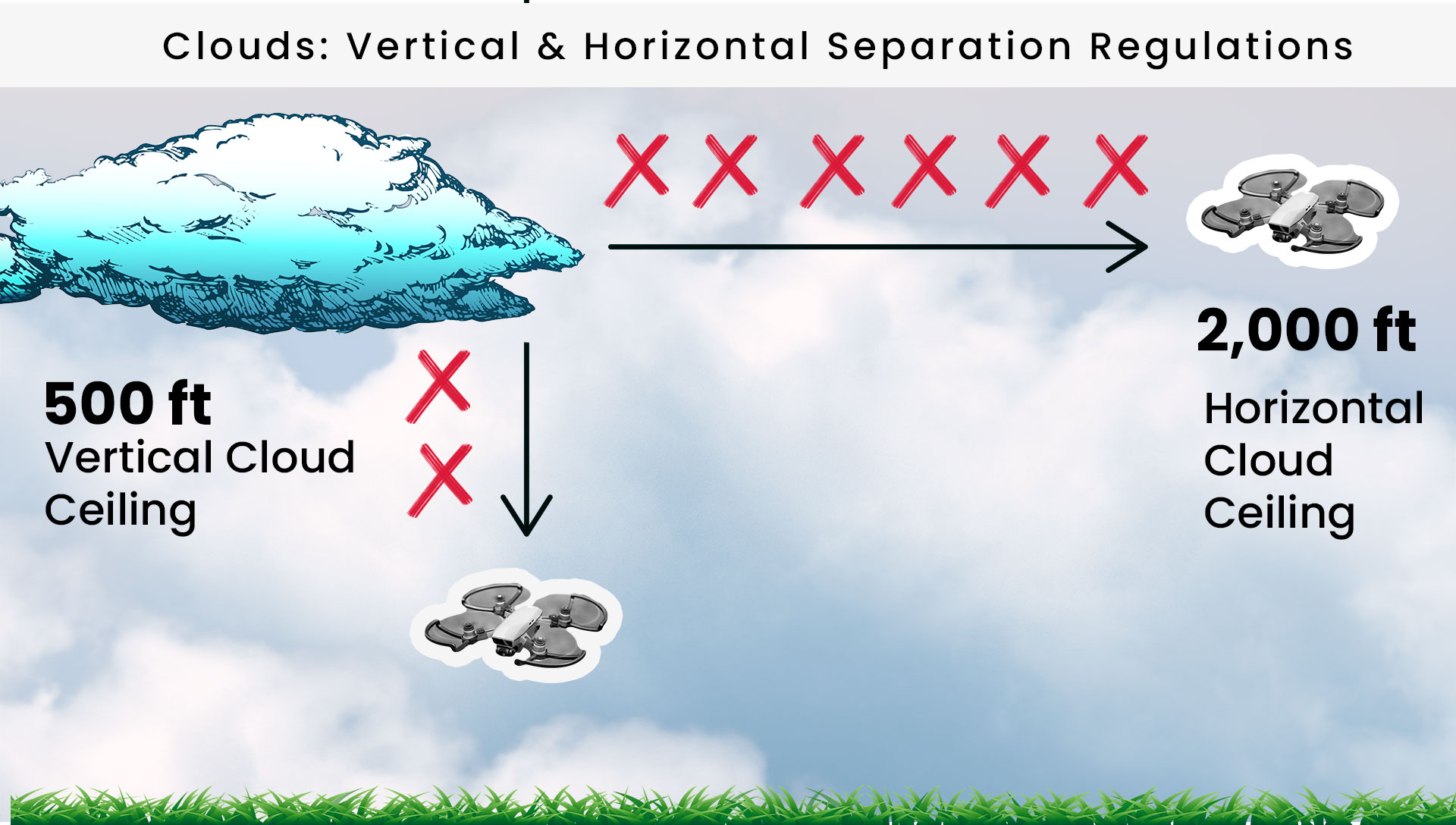
500-Foot Vertical Rule
You must stay at least 500 feet below the lowest layer of clouds.
This makes sure you’re never flying upward into a cloud layer where visibility drops and manned aircraft might be passing through.
2,000-Foot Horizontal Rule
You must stay at least 2,000 feet horizontally away from any cloud.
This horizontal buffer keeps your drone far enough away from clouds that you’re not at risk of flying blind—or surprising a low-flying aircraft emerging from cloud cover.
Example in Action
If the cloud ceiling is reported at 800 feet AGL, then:
- You must stay at or below 300 feet AGL
- (Because 800 ft – 500 ft = 300 ft max altitude)
Even though the legal Part 107 altitude is 400 feet AGL, the cloud ceiling changes that. The lowest wins.
Tower Inspections
and Cloud Ceilings

Revisiting the Rules: Altitude Limits and Cloud Ceilings
How Cloud Regulations Still Apply During Tower Inspections
Before we go any higher, let’s review what we already know:
- Under normal conditions, drones are limited to 400 feet AGL max altitude during flight.
- When clouds are in the sky, you must also stay:
- At least 500 feet below the lowest cloud layer
- At least 2,000 feet horizontally from any clouds
These cloud clearance rules exist to keep aircraft from flying into clouds where visibility drops and mid-air collisions are more likely.
So what happens when you’re inspecting something taller than 400 feet?
That’s where an exception comes in — but not without limits.
FAA’s Tower Inspection Exception
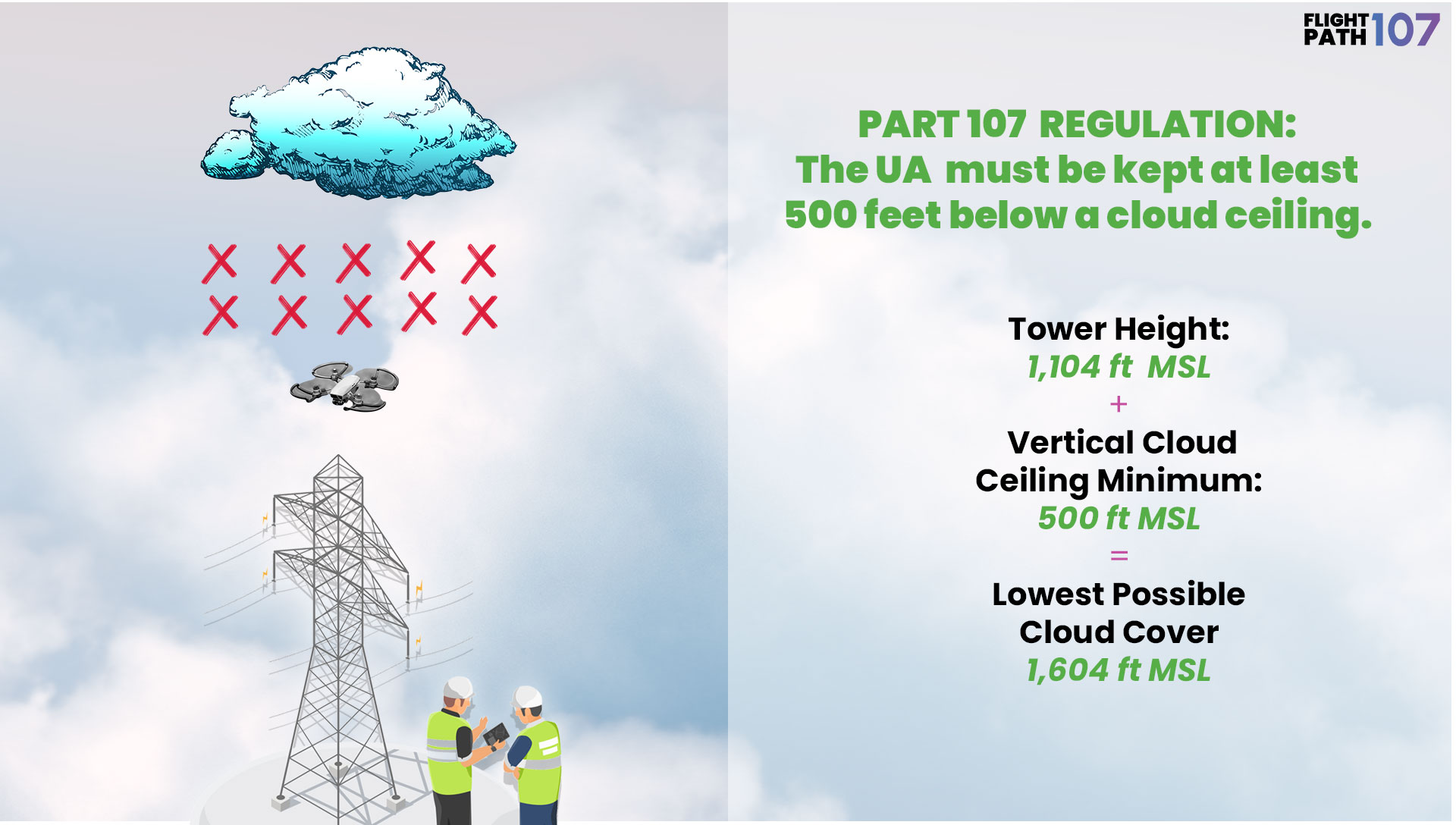
Let’s say you’re inspecting a lighted tower that reaches 1,104 feet MSL.
To stay compliant with FAA rules, you need to remain at least 500 feet below the clouds, even during a legal tower inspection.
What’s the minimum cloud ceiling required?
- Tower height: 1,104 feet MSL
- Required vertical cloud clearance: +500 feet
- Minimum cloud ceiling: 1,604 feet MSL
Answer: 1,604 feet MSL
This means if clouds are any lower than 1,604 feet, you cannot fly to the top of the tower without breaking FAA regulations.
To legally inspect the very top of the tower. The cloud ceiling must be at least 500 feet higher than the top of the tower.
In this case, that means a minimum ceiling of 1,104 MSL + 400 MSL = 1,604 feet MSL.
Sectional Chart Practice
Tower 10NM South of Jamestown Regional Airport (JMS)
Chart Skills
You’re inspecting a set of lighted towers about 10 nautical miles south of Jamestown Regional Airport. Let’s use the sectional chart legend data to figure out the minimum cloud ceiling required to stay compliant with FAA rules.
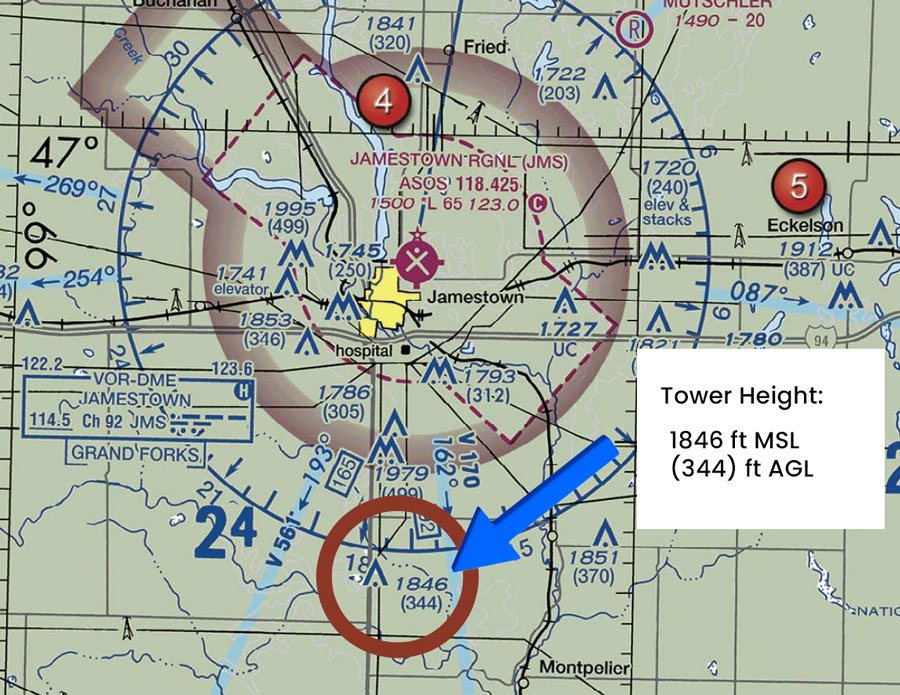
Step 1: Read the Chart
The FAA requires all drone flights to maintain a minimum of 500 feet below the cloud base.
So, to legally inspect the top of this tower, you need to add 500 feet to the tower’s height — whether measured in MSL or AGL
Sectional charts list tower heights in two ways:
- Top number = MSL (Mean Sea Level) – the height of the tower above sea level
- Bottom number (in parentheses) = AGL (Above Ground Level) – how tall the tower is from the ground
For this tower’s height we see on the sectional chart it labeled as:
- 1,846 feet MSL
- (344) feet AGL
Step 2: Apply the 500-Foot Rule
To stay compliant, you must ensure your drone stays at least 500 feet below the clouds during the inspection.
So the minimum cloud ceiling needed is:
- 1,846 ft MSL + 500 ft vertical buffer = 2,346 feet MSL
- 344 ft AGL + 500 ft vertical buffer = 844 feet AGL
This is the lowest possible cloud ceiling (in MSL and AGL) that still allow you to legally inspect the very top of the tower.