Understanding Stability:
Center of Gravity, Stalls, and the Critical Angle of Attack
Center of Gravity, Critical Angle of Attack, and Stalls are three foundational elements that determine whether your drone stays in stable flight — or drops from the sky in a blaze of disappointing and potentially hazardous glory.
Let’s start with the core concepts:
1. Center of Gravity (CG)
Key Terms
The Center of Gravity (CG) is the point on your drone where all its weight is evenly balanced. If you were to balance the drone on your finger, the spot where it stays level — not tipping forward, backward, or to the side — is its CG.
- If the CG is too far forward (nose-heavy), you may need to pull up more to stay level.
- If the CG is too far back (tail-heavy), the drone becomes harder to control and may stall more easily.
Remember:
- When adding or removing equipment, such as cameras or sensors, make sure the CG stays within the limits specified by the manufacturer.
- Always evaluate the CG of the sUAS after making changes to avoid issues with stability and performance during flight.
2. Stall
Key Terms
A stall happens when your drone can no longer generate enough lift to stay airborne — usually because of a bad angle between the airflow and the wing or rotor blade.
The drone’s propellors loose its ability to generate enough lift to keep the aircraft flying, due to the angle it is positioned at while in flight becoming too steep. When that angle exceeds a safe limit, lift drops dramatically.
- It’s not a power issue — it’s an airflow issue.
- Stalls occur when the angle of attack becomes too steep and airflow breaks down.
3. Critical Angle of Attack (AoA)
Key Terms
The critical angle of attack is the steepest angle a wing or rotor can handle before it stalls.
- It’s a fixed angle — determined by the design of the aircraft. Most aircraft—drones included—reach this critical angle between 15° and 20°.
- Exceed it even briefly, and your drone will lose lift and stall.
Think of critical angle of attack as the very serious “no-go” zone for your sUAS as its turning. This is where your drone is saying, “Hey now, this angle is too steep for me to maintain balanced flight!”
How These Three Concepts Work Together
Airborne Dynamics
Now that you’ve got the key definitions down, let’s connect the dots, and then look more closely about the aerodynamics at play:
- If your CG is off (too nose or tail heavy), you may be flying close to your critical angle of attack just to stay level.
- As you increase pitch during a climb or sharp turn, your drone gets closer to that critical angle.
- If the critical AoA is exceeded — even with full power — a stall will occur.
Going Deeper:
Critical Angle of Attack
Weight, Speed, your sUAS Aerodynamics, and Airflow
Airborne Dynamics
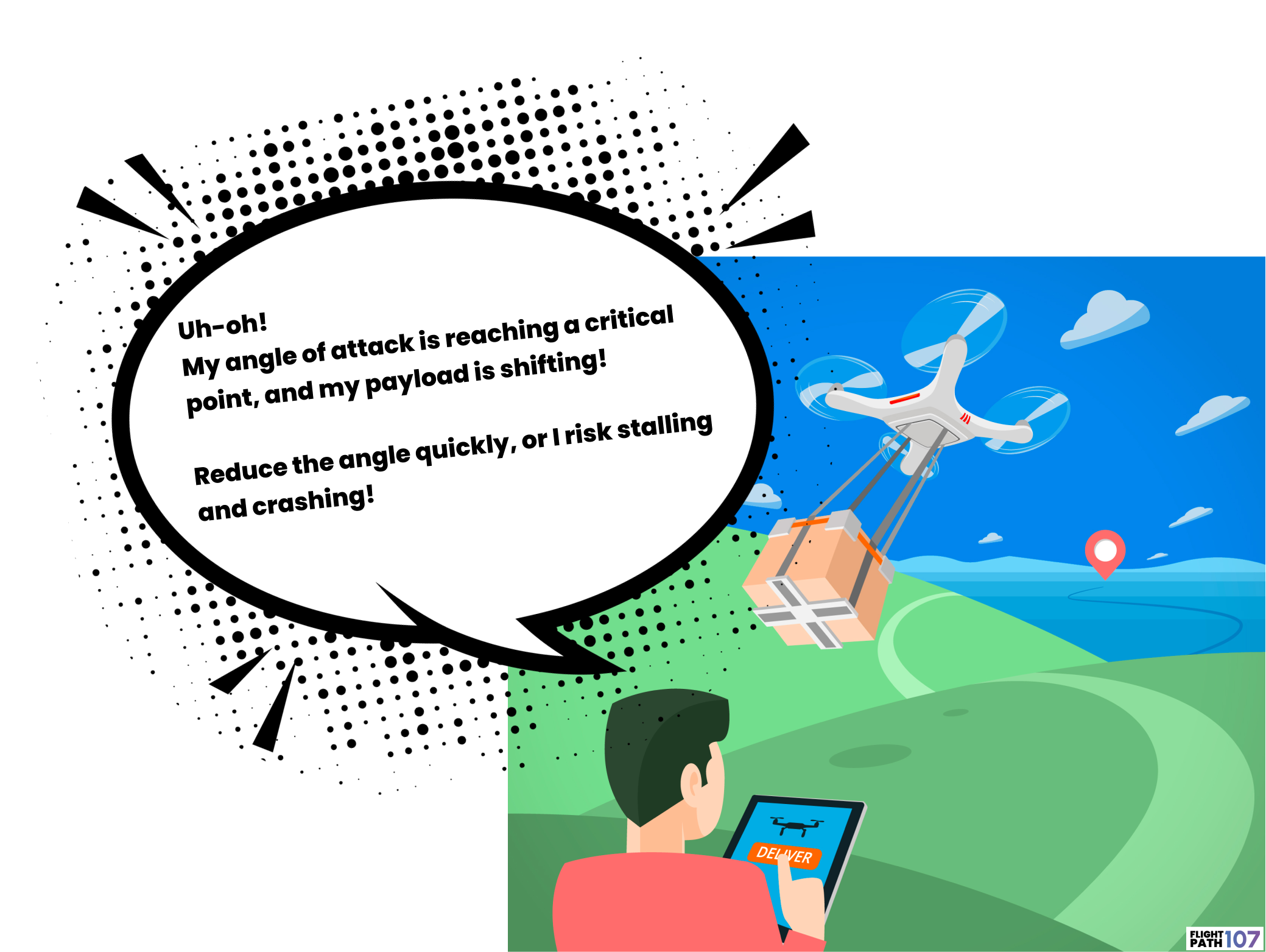
Now that we have defined the Center of Gravity, the potential for Stalls, and the Critical Angle of Attack, it’s time to zoom in on the CaO itself. This section breaks down why it’s so crucial to drone flight—and what it does and does not depend on.
What Is the Critical Angle of Attack?
The official FAA definition is as follows: The Critical Angle of Attack (CaO) is the maximum angle between the chord line of a wing or rotor blade and the direction of oncoming airflow before a stall occurs.
- This angle is fixed by design—meaning it’s built into the physical shape and structure of the drone’s lifting surfaces.
- No matter how much the drone weighs or what altitude you’re flying at, this angle doesn’t change.
Why Is That Important?
If your drone exceeds that angle during flight, a stall becomes inevitable—not because of external conditions, but because the wing can no longer generate stable lift due to turbulent airflow.
This makes your job as a drone pilot very clear: Avoid pitching the drone so aggressively that the angle of attack surpasses this critical threshold.
Know your aircraft—different drones (especially fixed-wing vs. multi-rotor) will reach the CaO differently, but the concept applies across the board.
Weight Changes Flight Speed—Not Critical Angle
Here’s a key point many pilots miss:
- The CaO is not affected by how heavy the drone’s weight is.
What does change with added weight:
- The speed needed to maintain level flight increases.
- The drone may reach the CaO at a faster airspeed, but the angle at which that stall happens stays exactly the same.
This is why high-payload missions require extra attention to flight speed and pitch—you’re flying closer to the edge of stall risk even though the angle of attack limit hasn’t changed.
Going Deeper:
Stalls in Action
Step-by-Step Towards a STall
Airborne Dynamics
In the visual aid below, you’ll find a step-by-step breakdown that explains what happens when an sUAS goes from a smooth, stable flight to the point where a stall occurs, plus how to recover from it.
What the visual is showing you is, as the drone’s angle of attack increases, it reaches a critical angle where the airflow becomes turbulent, diminishing lift capacity. This leads to a stall, causing the drone to lose altitude and potentially spin out of control.
With the right recovery action preparedness, you can regain stability and continue flying safely.
Click image to enlarge:
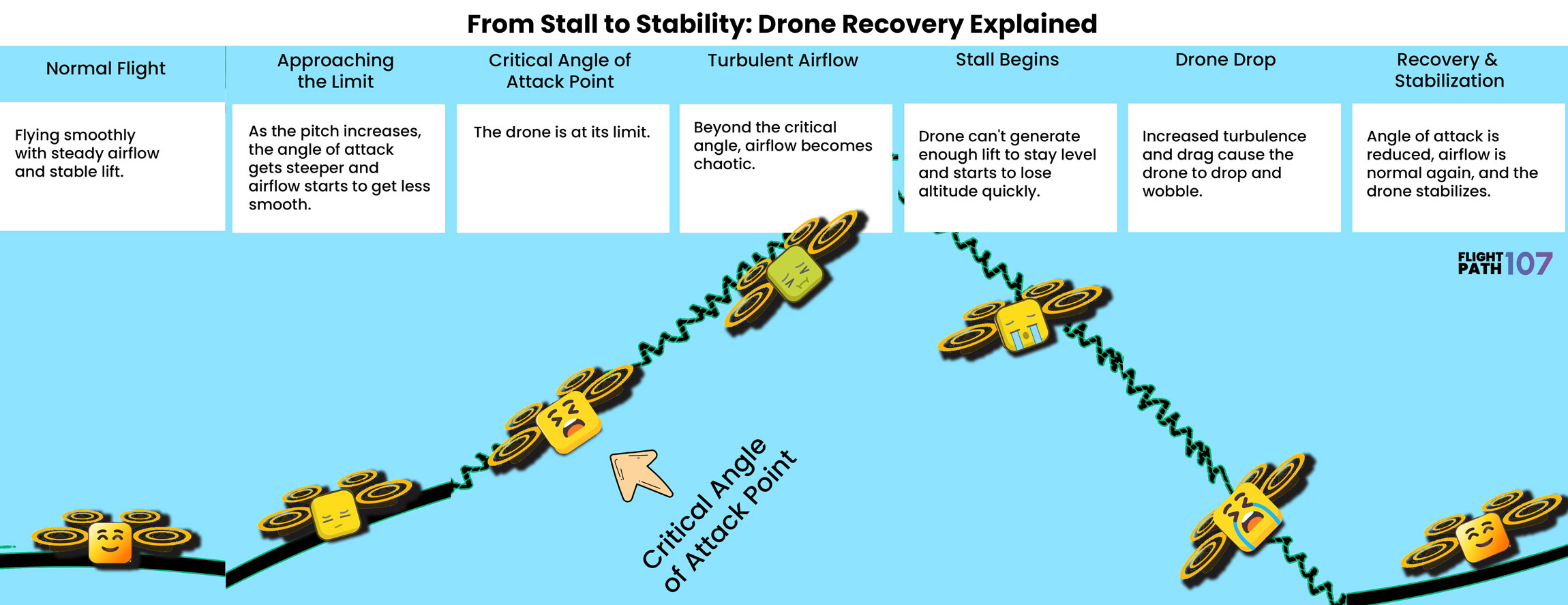
- 1Normal Smooth Flight
The aircraft is flying smoothly, maintaining a balanced angle of attack. Lift is stable. - 2Approaching the Angle Limit
As you increase the drone’s pitch, the angle of attack gets steeper. - 3Reaching CRITICAL ANGLE OF ATTACK Point
When you reach the critical angle of attack, the airflow over the wings starts to get turbulent. The sUAS is in its ‘no-go’ zone. - 4Increasing Disrupted, Turbulent Airflow
Beyond this point, the airflow gets so turbulent it begins destabilizing the smooth lift the propellors usually is able to sustain. If you keep pushing, the UA won’t be able handle it, and will loose its stable ascent and stall. - 5Stall Occurs
A stall now happens when your UA’s propellers can’t generate enough lift to keep flying level. This is when your UA is pushed to its breaking point and a stall occurs. - 6Experiencing Drone Drop
The increased angle of attack, with all that turbulence and drag, causes the lift to drop rapidly, and the drone starts to lose altitude and might even spin out of control. - 7Prevent Crash: Recover & Stabilize
To recover, you ease off the pitch, lower the angle of attack, and let the airflow smooth out again. Once the airflow is back to normal, the drone stabilizes, and you’re good to go.
Going Deeper:
Center of Gravity
Nose-Heavy Drone
Airborne Dynamics
What It Means: The front of the drone is heavier.
Effect: The drone needs to fly faster to avoid stalling. For example, if it normally stalls at 55 mph, the extra weight in the front might cause it to stall at 65 mph.
Why: The heavier front shifts the center of gravity forward, making it harder for the drone to maintain level flight. To counteract this, the drone must fly faster to generate enough lift to stay in the air and prevent stalling.
Tail-Heavy Drone
Airborne Dynamics
In aviation, “aft” refers to the rear part of the aircraft, or towards the back.
- What It Means: The back of the drone is heavier.
- Effect: The drone can fly slower before it stalls. For example, if it normally stalls at 55 mph, the extra weight in the back might lead it to stall at 45 mph.
- Why: The heavier back shifts the center of gravity toward the aft part of the aircraft, making it easier for the drone to pitch its nose up. This allows the drone to achieve a higher angle of attack, which can generate lift at lower speeds.