Getting Started
What are Drone Categories?
sUAS Classifications
Before we get into certifications and rules about flying over people (covered in the next two lessons), this first section gives you the full breakdown of how small Unmanned Aircraft Systems (sUAS) are categorized.
Why sUAS Categories Matter
The FAA uses four drone categories—1, 2, 3, and 4—to classify drones based on their weight, kinetic energy, construction, and compliance. These categories don’t just label the drone—they determine what you’re legally allowed to do with it, especially when flying over people or in more complex situations.
Knowing your category helps you answer questions like:
- Can I fly over a group of people at a festival?
- Does my drone need FAA certification or just a Remote ID?
- Are guards required over the propellers?
First we have the categories themselves::
suAS categories 1, 2, 3, and 4 are classifications for drones based on characteristics such as their size, weight, and risk factors. These are specific parameters such as the weight of the sUAS, or if there are exposed rotating parts that could lacerate someone’s skin if struck.
These things matter when it comes to safety, especially if there are a lot of people beneath you where an accident could do some serious harm to someone.
Then we have the Requirements and Permissions for Each Category:
These categories determine levels of regulation and certification mandated by the FAA for the sUAS, and dictate what kind of operational regulations apply.
For instance, the requirements for flying an sUAS flight mission over an an outdoor concert where a large assembly of people are gathered will change depending on the Category of sUAS you are flying.
Drone Categories 1-4
The 4 Key Features That Determine Your Category
sUAS Classifications
To determine your drone’s category, the FAA considers four physical and operational characteristics:
You’ll see soon that when an sUAS has aspects to it that would make it much more damaging in the occurrence of a crash, there are a lot more regulations that do not allow it to perform certain types of flights without special permission. You’ll also see how the smaller, lighter, and safe the drone us, the more you’re able to do with it legally or without special permission.
With that in mind, lets look at the 4 key considerations when determining sUAS categories 1, 2, 3, and 4:
1. Weight of the sUAS
How heavy is the drone including all attachments and payload?
-
The total takeoff weight influences how much potential damage the drone could cause in a collision.
2. Kinetic Energy of the sUAS
How fast is the drone going and how much does it weigh?
- This has to do with momentum: How much energy the drone would release if it were to hit something (or someone)?
- Higher kinetic energy = higher risk. A calculation of how much force your drone could deliver in a crash—based on weight + speed.
3. Exposed Rotating Parts
Can the propellers or spinning parts cut or harm someone?
- Some drones require guards to prevent injury, especially in Categories 3 and 4.
4. Certification of Compliance
Does the drone meet FAA safety standards for its category?
- In some cases, documentation like a Declaration of Compliance (DOC) is required to prove the drone is designed to operate safely.
The 4 Key Features That Determine Your Category
sUAS Classifications
Now lets think about the different types of scenarios we may be flying over. What’s going on beneath us, and what does that mean we can and cannot do?
Let’s take a look at each one in general, and later we’ll break it down by Category 1, 2, 3, anmd 4.
1. Flight in Transit vs. Hovering
Are you just flying through the airspace, or are you hovering over it? The rules differ.
There’s a difference between a drone passing briefly over a person or area vs. staying above it in place (hovering).
- Transit = Flying from Point A to Point B, crossing overhead momentarily.
- Hovering = Staying in position directly above someone or something.
Why it matters: Hovering increases exposure time and risk, so the FAA treats it differently than a quick flyover. Certain operations may only allow transit—not hovering.
2. Flight Over Bystanders
Can your drone legally fly over people who aren’t part of your crew or mission?
This refers to flying your drone directly over people who aren’t involved in the flight operation (i.e., not your crew or participants).
- Example: Filming a park where pedestrians are walking.
- Why it matters: If your drone were to experience a fly away and crash, these people would be at serious risk. The FAA has strict limitations on which categories are allowed to do this—and under what conditions.
3. Flight Requiring a Restricted Access Zone
Is it required to keep bystanders out of the area entirely?
This means you need to secure the flight area so that only people involved in the operation are nearby.
- Example: Filming a construction site where the perimeter is blocked off.
- Why it matters: Creating a controlled zone keeps bystanders away. This controlled zone reduces the chance of injury and helps mitigate risk, like a random person unknowingly walking right into your flight path zone because the area wasn’t marked off.
3. Flight Over Open-Air Assembly
Are you allowed to fly over large gatherings, like concerts or parades?
This involves flying over large groups of people gathered in one area, like concerts, festivals, or sporting events.
- Example: Capturing footage over a crowded outdoor music festival.
- Why it matters: More people = higher risk. Flying over an assembly generally requires a higher FAA certification level or type, and stricter safety measures.
Category Breakdown:
1–4 at a Glance
Let’s walk through what sets each category apart.
Category 1 Drones
Lightweight • Low Risk • Least Regulation
- Weighs under 0.55 lbs (250 grams)
- No FAA certification required beyond registration.
- Must not have exposed rotating parts capable of lacerating skin.
- Allowed to fly over people under certain low-risk conditions.
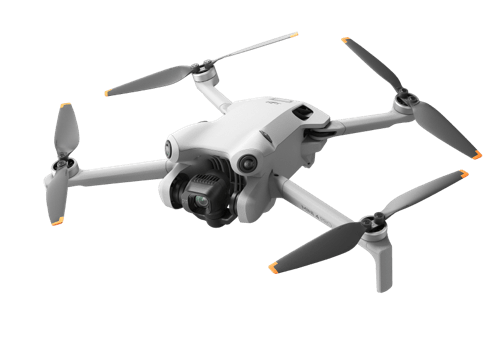
Example: DJI Mini 4 Pro – A common lightweight drone used by creators and hobbyists.
Category 2 Drones
Mid-Weight • Moderate Risk • Some Certification Required
- Weighs 0.55–55 lbs
- Must not exceed 11 ft-lbs of kinetic energy in a crash.
- Propellers must not cause skin laceration on impact.
- Requires a Declaration of Compliance (DOC) and labeling.
- May fly over people, but with limitations.
Common Uses: Mapping, surveying, agricultural monitoring, infrastructure inspection.
Category 3 Drones
Higher Weight • Elevated Risk • More Restrictions
- Typically same weight as Cat 2, but used in higher-risk contexts.
- Must not exceed 25 ft-lbs of kinetic energy.
- Propeller guards required or parts must be enclosed.
- Cannot fly over open-air assemblies.
- Can fly over people in controlled-access areas, with restrictions.
Category 4 Drones
Heavy Duty • Highest Risk • Full Certification Required
- Typically larger than 55 lbs
- Operates under an FAA-issued Airworthiness Certificate
- Often used in complex, industrial, or cargo operations
- Must meet full safety and certification requirements for each operation
🛠 Example: AeroVironment Quantix (used in advanced surveying and large-scale industrial mapping)
UA Weight, Kinetic Energy, and Rotating Parts
Physical Characteristics That Shape Your sUAS Category Classification
UA Weight
The category of your UA will change depending on its weight, as each weight class has specific rules and regulations that dictate where and how you can fly.
- Category 1: Under 0.55 lbs (250 grams)
- Category 2: 0.55-55 lbs
- Category 3: Over 55 lbs
UA Kinetic Energy
Kinetic energy is the energy an object has based on its mass and speed. The heavier the UA and the faster it flies, the more kinetic energy it has. Higher kinetic energy increases the potential harmful impact of the UA in the event of a collision.
Kinetic energy thresholds by category:
- Category 1: No specific threshold
- Category 2: Up to 11 pounds of kinetic energy in a crash.
- Category 3: Up to 25 pounds of kinetic energy in a crash.
- Category 4: Limits depending on the operation
UA Exposed Rotating Parts
Exposed rotating parts are drone components, like propellers, that can cause lacerations if they hit a person during a crash.
- Category 1 and 2 drones may have rotating parts exposed, but they must not have the ability to lacerate human skin on impact.
- Category 3 drones must have their rotating parts covered, such as with propeller guards or cases, to prevent injury.
- Category 4 drones may have exposed rotating parts, but only with the proper permissions and if they meet specific requirements.