Understanding ATIS vs AWOS/ASOS
Learn the key differences between these essential weather and airport information systems.
Picture This:
Your client needs aerial footage of their new solar farm by noon, and you’ve got your drone ready to launch. Your mission site is 4 miles northeast of the field, and you need to know what’s happening in the airspace around you. The sky looks clear, but you notice a few clouds rolling in from the west.
You pull out your phone and first check the airport’s ATIS on 124.25 MHz. A recorded voice—human, not robotic—tells you: “Information Delta, wind 310 at 12 gusting 18, visibility 10, ceiling 4,000 broken, temperature 68, altimeter 30.15. Runway 31 in use for departures. Advised of birds in the vicinity of the field. Contact ground on 121.9…”
That’s helpful—you know the active runway, there are birds around, and the wind is gusty. But you want to double-check conditions at your actual launch site. You switch over to a nearby small, untowered airport just 2 miles from where you’ll be flying. Their AWOS on 118.375 MHz reports: “Wind 320 at 10, visibility 10, few clouds at 3,500, temperature 70, altimeter 30.14…”
Now you have the full picture: ATIS gave you the bigger operational context—runway in use, NOTAMs, bird activity. AWOS gave you hyper-local weather right where you’re flying. Both matter, and both give you different pieces of the puzzle.
As a drone pilot you’re operating in the same airspace system as manned aircraft. You do not want to find yourself in trouble with the FAA or flying your drone into a low flying aircraft.
That’s why learning the automated broadcast frequencies from airports will be helpful. Before each flight, put it on your checklist to be in the habit of checking these. ATIS, AWOS, and ASOS are how that system keeps pilots informed without clogging radio frequencies.
Knowing when and why to use ATIS versus AWOS/ASOS helps you:
- Build accurate pre-flight situational awareness
- Understand what ATC already expects you to know
- Communicate efficiently and professionally when operating near towered airports
- Make smarter go/no-go decisions based on real, current conditions
Even if you’re not talking to ATC directly, these broadcasts give you access to FAA communication around runway use, traffic flow, weather expectations, and operational safety around you.
A skilled drone pilot knows how to read the environment before launching, and these systems are part of that environment.

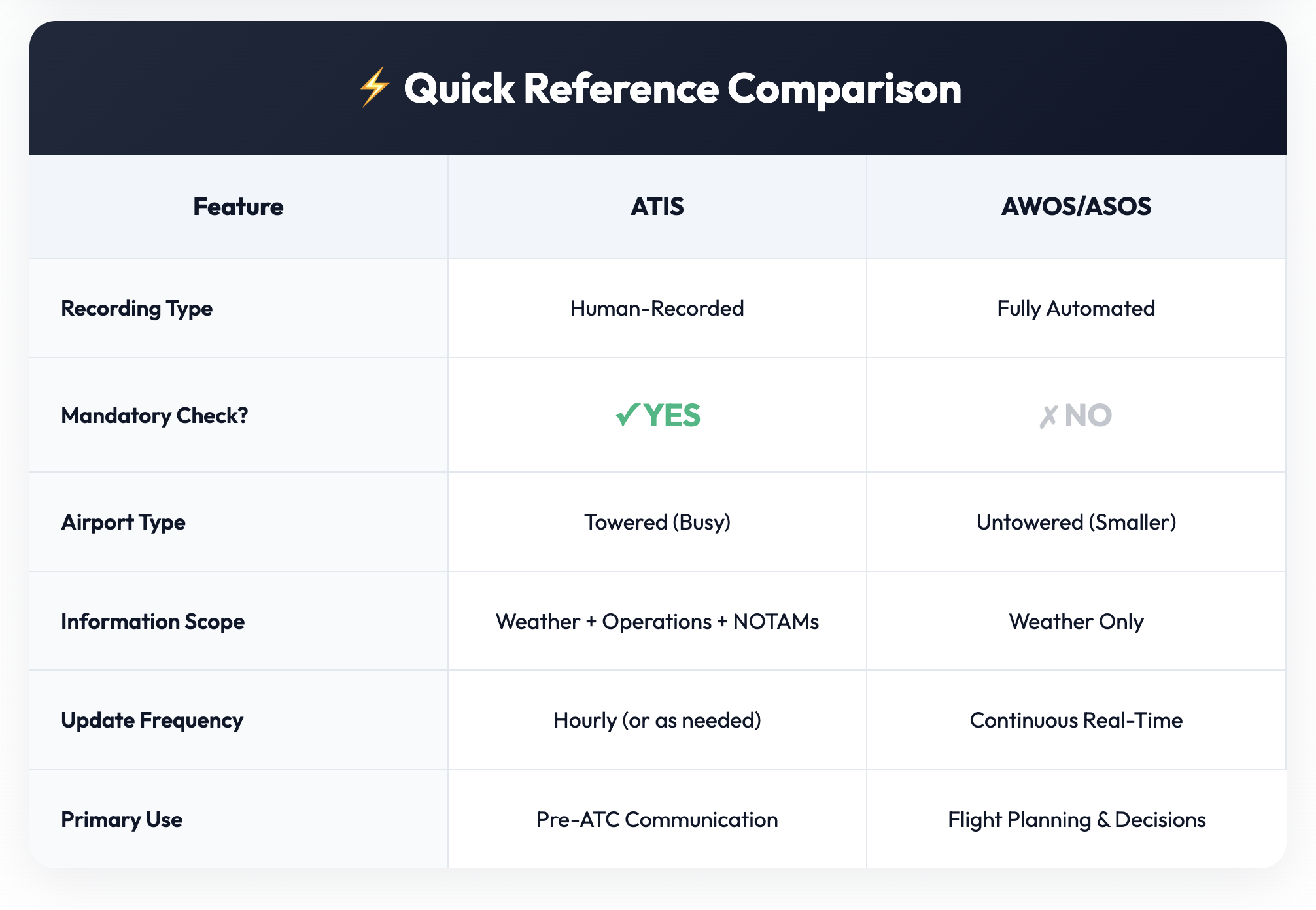
ATIS
Automatic Terminal Information Service
 Mandatory to Check Before ATC Contact
Purpose
Provides recorded, repetitive broadcast of airspace-relevant information in a specific terminal area at busy airports.
- Human-recorded updates on airport operations
- Includes weather, runway conditions, NOTAMs, and ATC info
- Used at towered airports
- Updated hourly or more frequently during significant changes
- Broadcast continuously on a dedicated frequency
- Helps streamline communication and flight prep
Key Requirement

AWOS / ASOS
Automated Weather Observing/Reporting Systems
ℹ️ Not Mandatory to Check
Purpose
Both AWOS & ASOS are automated systems that provide real-time weather observations for flight operations, and pre-flight planning.
- Fully automated and operates continuously
- Common at untowered airports or those without ATIS
- Focuses solely on current weather conditions
- Reports temperature, wind, visibility, clouds, pressure
- ASOS typically at larger airports
- AWOS typically at smaller airports
Key Difference
AWOS/ASOS are not mandatory to check before communicating with ATC. While they provide valuable weather data, there’s no requirement to listen to them before contacting controllers.
📋 ATIS Special Rule: Sky Condition / Visibility
When an ATIS broadcast does not include information about sky conditions or visibility, it automatically indicates the following favorable conditions:
→ Ceiling: The cloud base is at least 5,000 feet above the ground
→ Visibility: The visibility is 5 statute miles or more
This is standard practice for ATIS broadcasts, indicating conditions are good enough (clear skies and good visibility) for pilots to operate without special weather considerations.
🎯 Remember for the Exam
- ATIS is mandatory — Always check before contacting ATC at towered airports
- AWOS/ASOS are optional — Useful for weather but not required before ATC contact
- No sky/visibility mentioned in ATIS? Assume 5,000 ft ceiling and 5 SM visibility
- ATIS = Busy airports with comprehensive information
- AWOS/ASOS = Smaller airports with automated weather only
What About METAR Reports?
You might be wondering: “Why check ATIS or AWOS/ASOS when I can just read a METAR report?”
Here’s the key: METAR reports aren’t a separate weather source – they’re simply the written/text format of the same weather data that AWOS/ASOS broadcasts verbally.
Think of it this way:
→ AWOS/ASOS broadcasts = You listen to a robot voice reading weather data
→ METAR report = The exact same data, but in coded text format you read
When you check a METAR on websites like aviationweather.gov or in apps like ForeFlight, you’re getting the same information that AWOS/ASOS is broadcasting—just in written form instead of audio.
What makes ATIS different: ATIS includes more than just METAR weather data. It adds operational info like active runways, NOTAMs, bird activity, taxiway closures, and specific ATC instructions. That’s why you can’t just read a METAR and skip ATIS at towered airports.
Bottom line: Checking a METAR online = checking AWOS/ASOS data. But if you’re near a towered airport, you still need ATIS for the operational details beyond weather.