METAR & TAF REPORTS

> Part 1 of 6

METAR vs. TAF Reports

Which Report Do I Check? METAR vs. TAF

MISSION: Pawnee Grassland Summer Documentation

Field Notes: Pre-Mission Planning

Mission Planning | Is this forecast fresh? (maybe delete this second subhead? the word mission is in all 3 lines)

You’re planning your quarterly documentation flight to contribute to the citizen science initiative, Aerial Atlas Archive, at Pawnee National Grassland—60 miles northeast of Denver. This is your summer visit, one of four quarterly trips to track ecological changes in the shortgrass prairie.

You want golden hour footage. That means arriving on-site by 5:30 PM, launching around 7:00 PM, and shooting until civil twilight fades around 8:30 PM. That’s a solid 3 hour window.

The next question is, when?

You open your weather app and check the forecast for tomorrow, showing that Thursday is “mostly sunny with a chance of rain.” Friday has a chance of afternoon thunderstorms. You need more specific and timely forecasts to know if the mission is a go.

As a Part 107 pilot, you know a generic weather app isn’t enough. You need aviation-grade data.

In order to get that, you’ll check what the FAA refers to as METAR and TAF reports, which are issued from the nearest airport.

But which one do you check first? And what’s the difference?

You pull up the TAF report for Fort Collins-Loveland Airport (KFNL). It shows a 30-hour forecast starting tomorrow at noon. Perfect for planning.

Then you check the METAR. It shows current conditions right now—what’s actually happening at the airport this moment.

Here’s what you just learned: TAF tells you what’s forecasted for your flight window. METAR tells you what’s happening now. You need both—TAF for planning ahead, METAR for final verification.

Without understanding this difference, you’d be flying blind. how about: Without understanding this difference your mission could run into trouble.

In this Lesson You’ll Learn:

  • The planning report, known as a TAF Report.
  • The “right now” report, known as a METAR report
  • How to use both reports together for complete weather awareness for drone flight mission planning.

Key Weather Elements Reported

TAF and METAR are both aviation specific weather reports broadcasted and used by the FAA.

These reports display almost identical weather information, with just a few specific differences. You’ll notice in the chart below a variety of weather conditions that can greatly affect the safety and success of your flight mission, from wind gusts to cloud coverage and more.

In an upcoming lesson you’ll learn how to read the reports themselves.

Weather Elements Covered:

METAR & TAF REPORTS

  • Wind (speed, direction, gusts)
  • Visibility (in statute miles)
  • Weather Phenomena (rain, fog, mist, thunderstorms, etc.)
  • Cloud Coverage (clear, broken, overcast, and cloud heights)
  • Present Temperature & Dew Point (METAR only)

  • Present Altimeter Setting (METAR only)

METAR vs. TAF Reports

The essential difference between these two reports: one gives you forecasted weather predictions, the other gives you real-time weather updates.

Together, They Give You the Complete Picture:

  • TAF = What’s forecasted (planning ahead)
  • METAR = What’s happening now (final verification)

As a Part 107 pilot, we don’t take shortcuts with safety or compliance. Understanding weather, both forecasted and current, plays a huge part in that.
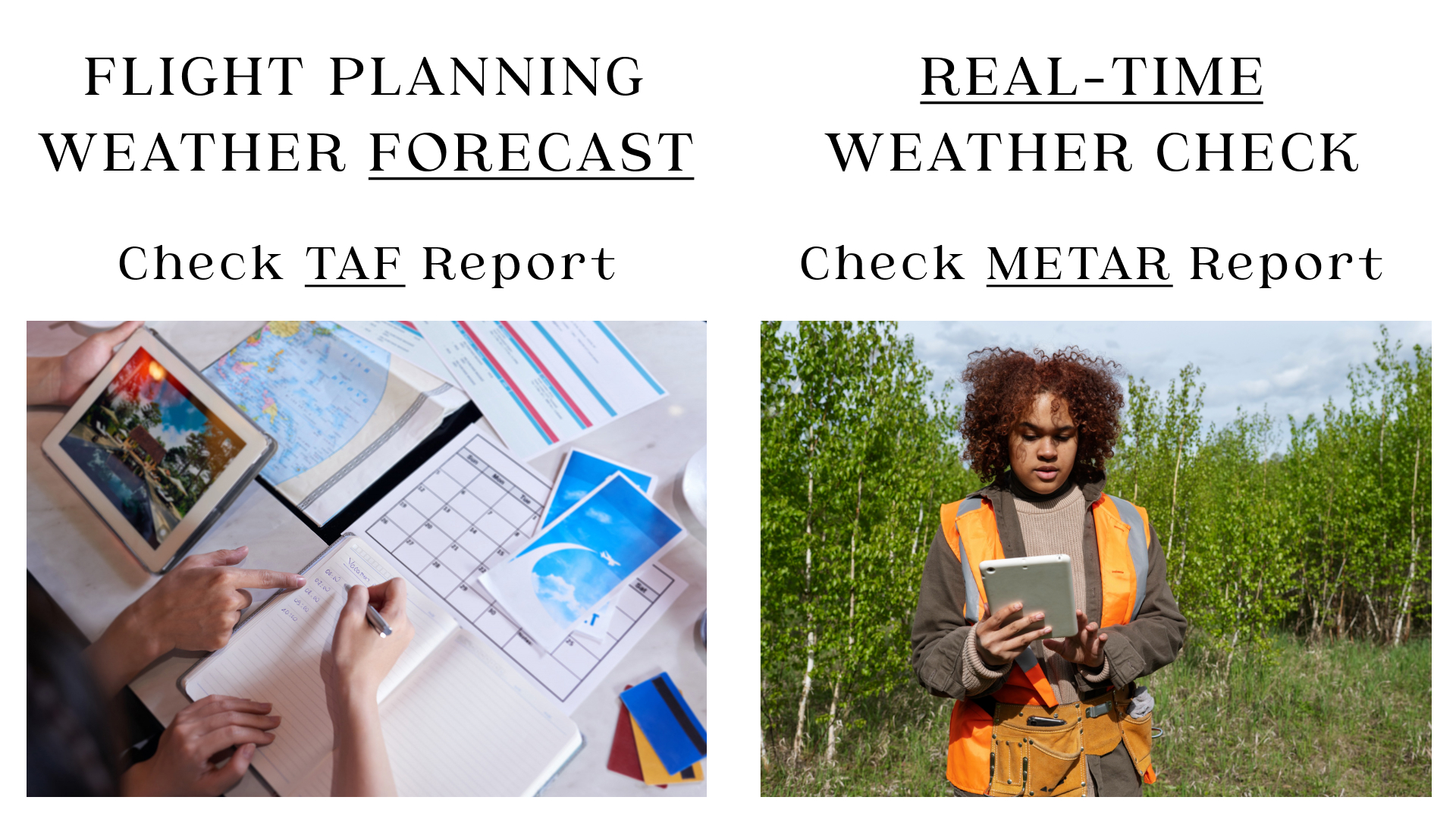

TAF Reports = Forecasted Weather

Essential for flight planning.

TAF (Terminal Aerodrome Forecast) reports offer a forecast of expected weather conditions over a 24 to 30-hour period, with updates issued every six hours.

Pilots use TAFs to anticipate weather changes—such as shifts in visibility, wind, and cloud coverage—which helps in flight planning and ensuring safety throughout the mission.

When you’d use TAF:

  • Planning tomorrow’s flight mission: Will it be clear skies or stormy?
  • Scheduling multi-hour jobs that could span different weather windows
  • Deciding the best time window to launch for optimal conditions

Important: Weather can shift as the atmosphere changes. Always cross-check TAF forecasts with the latest real-time METAR report before launching.

METAR Reports = Real-Time Weather

Essential for on-site weather monitoring.

METAR (Meteorological Aerodrome Report) reports are updated every hour (or more frequently if conditions change rapidly) and provide current weather data, including visibility, wind speed and direction, temperature, cloud cover, and atmospheric pressure at a particular airport.

When you’d use METAR:

  • Right before takeoff: What are the actual conditions right now?
  • During flight operations: Monitoring for any changes
  • Confirming the TAF forecast is still accurate

This report is essential for understanding the immediate weather conditions at the airport nearest to where you’re flying.

Lesson Practice Exam

METAR vs. TAF Reports (Defining Purpose)

1 / 5

Which statement correctly describes the difference between a TAF and a METAR?

2 / 5

Why are METAR reports important for flight operations?

3 / 5

How often is a METAR report typically updated?

4 / 5

What is the primary purpose of TAF reports?

5 / 5

How often is a TAF (Terminal Aerodrome Forecast) report routinely updated?

Your score is

The average score is 79%

0%

What’s Next?

In the following lessons, you’ll learn to read the the time on both TAF and METAR reports, so you know exactly from where and what time these reports are valid.