METAR & TAF REPORTS
> Part 6 of 6
Reading TAF Reports (Part 2)
Weather Elements
a few of these pages have a pretty long lag before the title comes up from below, like 4-5 seconds.
MISSION: Pawnee Grassland Summer Documentation
Field Notes: Pre-Mission Planning
Dawn to Dusk not critical, but this typeface does not look connected to the rest of the site.
You wake up to a beautiful prairie sunrise. The overnight camping decision paid off—the sky is starting to clear, just like the TAF predicted.
It’s early morning, and you’ve got two shoots planned for today: dawn in just an hour, and then tonight’s golden hour. Before you start prepping your drone for the dawn shoot, you pull out your phone for one final weather check.
You open the TAF report to see how things will look when dawn begins its first signs of light. You need to find the periods that cover your 6:00-8:00 AM dawn shoot AND your 6:00-8:30 PM golden hour flight tonight, then decode the weather elements listed for each.
You scan through the report and locate both time blocks.
Now you need to interpret the wind speed and direction, visibility, present weather, and cloud coverage specifically forecasted for each period, all encoded in the TAF.
This morning’s window: calm winds, 10+ statute miles visibility, clear skies, no weather phenomena predicted.
Tonight’s golden hour: similar conditions—light winds from the west, excellent visibility, clear skies.
You’re a go for both shoots.
This is the final piece of the weather puzzle. You’ve learned to read current conditions in a METAR, understand how weather changes over time in a TAF forecast, and now you can decode the specific weather elements within the TAF itself for multiple flight windows—giving you complete confidence in your flight planning from start to finish.
Time to fly. Well done!
In this Lesson You’ll Learn:
This is the final piece of the weather puzzle. You’ve learned to read current conditions in a METAR, understand how weather changes over time in a TAF forecast timeline, and now decode the specific weather elements within the TAF itself—giving you complete confidence in your flight planning from start to finish.
Time to fly. Well done! ✈️
Understanding TAF Weather Elements
Let’s decode the following TAF report’s weather elements.

1. Issue Time & Forecast Period
As a quick recap: In Part 1, you learned to read the TAF timeline. Now you can decode:
121720Z = Issue time (when TAF was published)
1218/1324 = Forecast valid period (24 to 30-hour window)
- FM, BECMG, TEMPO = When conditions change
Now let’s decode the weather elements that follow each time indicator.
Period 1
Overnight: 1506 (Midnight Local)
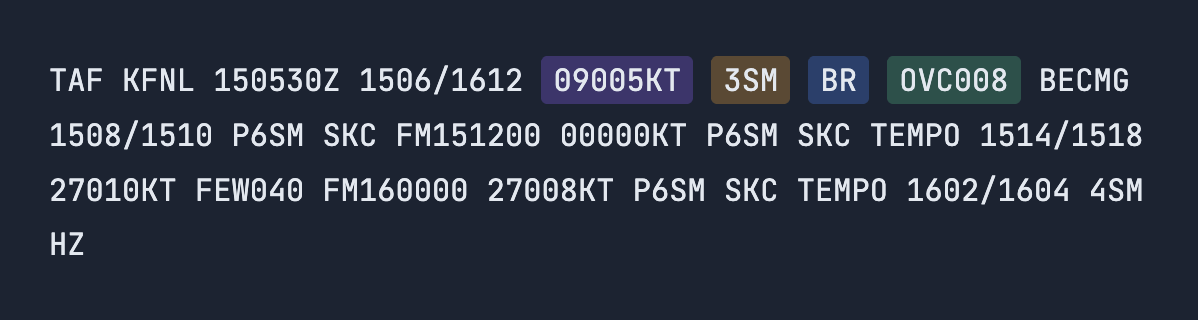
The forecast begins at 1506 (15th day at 06:00 Zulu = midnight local). Let’s decode all the weather elements for this period:
Wind: 09005KT
- 090 = Wind from 090° (east)
- 05 = 5 knots sustained speed
- KT = Knots
- No gusting winds
Light easterly breeze overnight at 5 knots. Very light and stable.
Visibility: 3SM
Visibility is 3 statute miles—right at the legal minimum.
Weather Phenomenon: BR
BR = Mist. Very fine water droplets in the air reducing visibility to 3SM.
Sky Condition: OVC008
- OVC = Overcast (sky completely covered)
- 008 = Cloud base at 800 feet AGL (008 × 100)
Complete overcast at 800 feet overnight—low clouds with the mist. Not flyable conditions.
Period 2
BECMG 1508/1510 (2-4 AM Local)
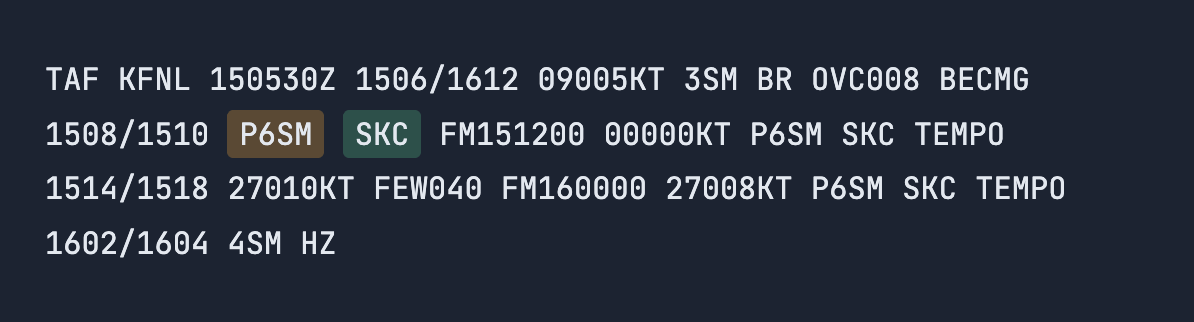
Between 08:00-10:00 Zulu (2-4 AM local), conditions gradually improve. This is a BECMG period—changes happen sometime during this 2-hour window.
Wind: No Wind Change Listed
- Wind remains at 09005KT from the previous period.
Visibility: P6SM
Visibility gradually improves to greater than 6 statute miles as the overnight overcast clouds and mist lifts.
Weather Phenomenon: None
No weather phenomena listed. The mist (BR) clears completely. Just clear air.
Sky Condition: SKC
Period 3 (Dawn Shot)
From 12:00 Zulu / 6:00 AM Local (FM151200)
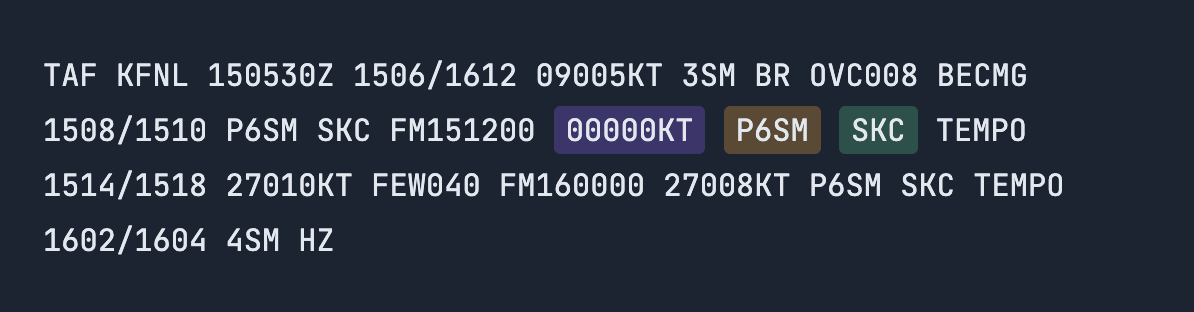
At 12:00 Zulu (6:00 AM local), new conditions begin instantly. This is your dawn shoot window (6:00-8:00 AM).
Wind: 00000KT
- 00000KT = No wind at all. Your drone will be rock-stable for those sunrise shots!
Visibility: P6SM
Greater than 6 statute miles. Excellent visibility for your dawn shoot—crystal clear prairie views!
Weather Phenomenon: None
No weather phenomena. No mist, no fog, no precipitation. Just beautiful dawn light.
Sky Condition: SKC
Perfect dawn conditions: Calm winds, excellent visibility, clear skies, no weather phenomena.
Period 4
Mid-Morning: TEMPO 1514/1518 (8 AM-Noon Local)
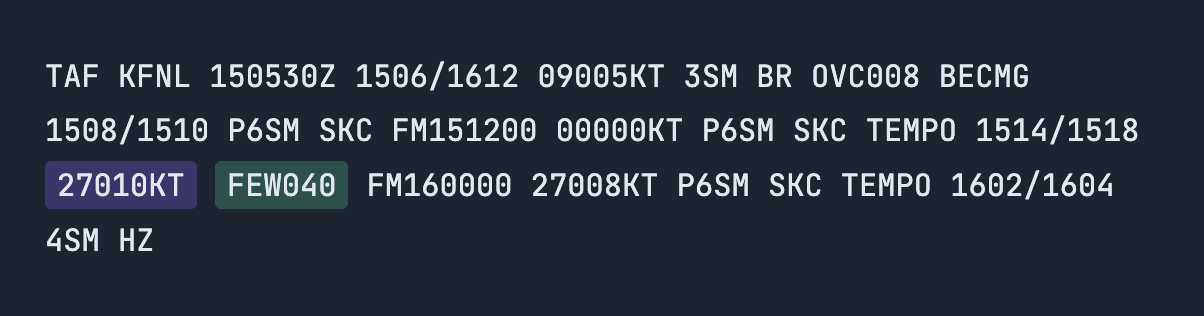
Between 14:00-18:00 Zulu (8 AM-Noon local), conditions may temporarily fluctuate. Brief changes that come and go—between your two shoots.
Wind: 27010KT
- 270 = Wind from 270° (west)
- 10 = 10 knots sustained
Mid-morning breezes may temporarily pick up from the west at 10 knots. Brief and intermittent.
Visibility
No visibility change listed. Visibility remains at P6SM from the previous period.
Weather Phenomenon
No weather phenomena listed. Clear conditions continue.
Sky Condition: FEW040
- FEW = Few clouds (1/8 to 2/8 sky covered)
- 040 = Cloud base at 4,000 feet AGL (040 × 100)
A few high clouds may briefly appear at 4,000 feet—well above your operations and barely noticeable.
Period 5 (Golden Hour)
From 00:00 Zulu / 6:00 PM Local (FM160000)
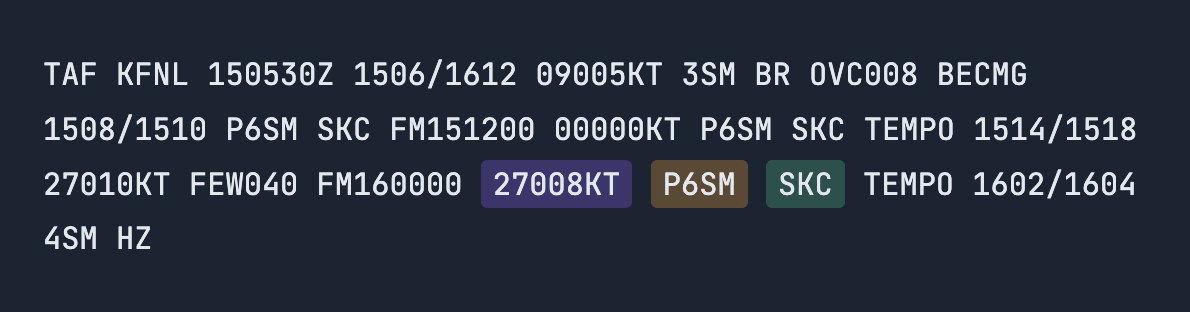
At 00:00 Zulu on the 16th (6:00 PM local), conditions change instantly again. This is your golden hour shoot window (6:00-8:30 PM).
Wind: 27008KT
- 270 = Wind from 270° (west)
- 08 = 8 knots sustained
Light westerly breeze at 8 knots. Smooth, stable, and ideal for filming!
Visibility: P6SM
Greater than 6 statute miles. Perfect for capturing golden hour light across the grassland!
Weather Phenomenon
No weather phenomena. Nothing to obstruct that golden hour light. Ideal for photography!
Sky Condition: SKC
Sky clear. No clouds to diffuse or block that beautiful golden light. Perfect evening skies!
Perfect golden hour conditions: Light winds, excellent visibility, clear skies, no weather phenomena.
Period 6 (Evening)
TEMPO 1602/1604 (8-10 PM Local)
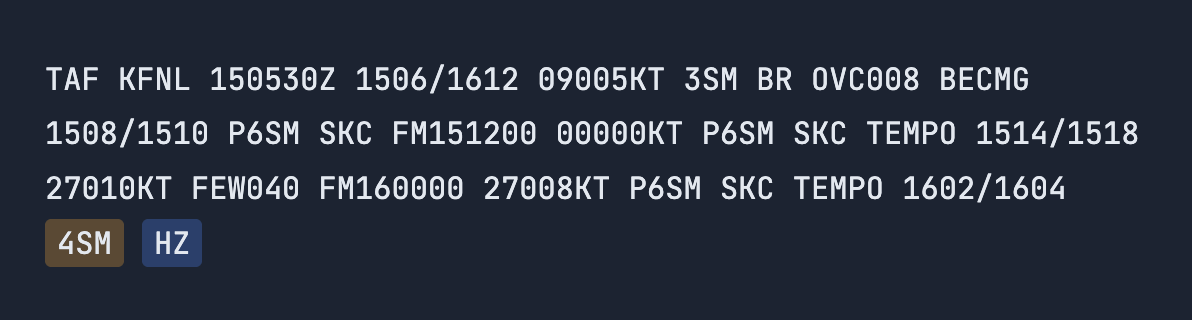
Between 02:00-04:00 Zulu (8-10 PM local), after your golden hour shoot ends at 8:30 PM, conditions may temporarily change.
Wind
Visibility: 4SM
Visibility may temporarily drop to 4 statute miles. Still legal.
Weather Phenomenon: HZ
HZ = Haze. Dust or dry particles suspended in the air, reducing visibility after sunset.
Sky Condition
No sky condition listed. Sky condition from the previous period continues. Still SKC—clear skies remain.

Lesson Practice Exam
Take your time.
What’s Next?
In the following lessons, you’ll learn to interpret wind codes, visibility notation, weather phenomena abbreviations, and cloud coverage—step by step, on both METAR and TAF Reports.
By the end of this module, you’ll be able to look at any METAR or TAF report and know exactly what conditions to expect.