Getting Started
Why it Matters for Flying
Fieldwork Foundations
If you’re operating your sUAS anywhere near an airport, understanding aircraft approach patterns helps you anticipate where manned aircraft will be before you ever hear or see them.
Knowing how to decode calls like “midfield left downwind Runway 9” allows you to:
- Track manned aircraft positions quickly
- Determine safe zones to pause or land your drone
- Stay situationally aware during sUAS operations
- Communicate clearly and confidently if needed
Lesson Focus
Part 107 Foundations
This lesson teaches you how to:
- Interpret common aircraft position calls on the CTAF (radio traffic frequency)
- Use compass directions and wind orientation to locate where aircraft are in relation to the runway
- Answer Part 107 questions about traffic patterns and approach positioning
On the Part 107 exam you’ll be asked to determine where an aircraft is located in relation to a runway (i.e. north, south, east, or west of the runway).
Landing Approach Foundations
Considering Flight Upwind vs. Downwind
Terminology
Pilots take off and land into the wind (upwind) because it provides better lift during takeoff and helps slow the aircraft down during landing.
Taking off or landing with the wind (downwind) increases ground speed, making departures less efficient and landings harder to control.
Understanding Standard Traffic Patterns Basics
Setting the Stage
When a manned aircraft is preparing to land, it doesn’t just fly straight toward the runway like it would during takeoff.
Instead, it enters a standard traffic pattern — a series of structured turns that guide the plane safely toward final approach. (Figure 1.0 below gives you an idea.)
This pattern supports predictable movement for both air traffic controllers and other aircraft.
As a remote pilot, you need to be able to visualize where a manned aircraft is in its approach — especially if you’re operating near an active airport and monitoring ATC radio calls.
In this lesson, we are only going to be focusing on what’s happening during the Downwind Leg approach.
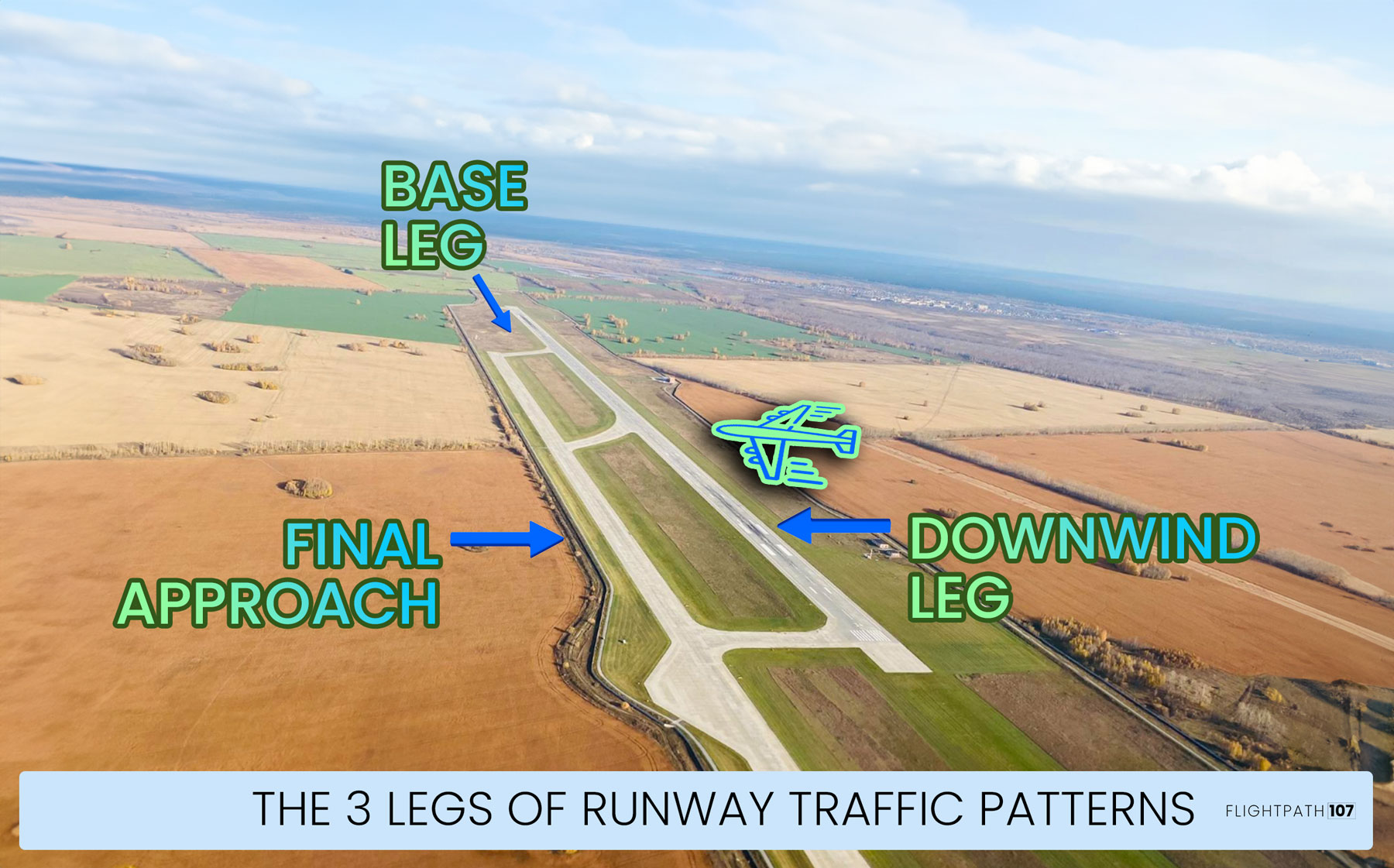
(Figure 1.0)
How Pilots Report Their Position to ATC
Setting the Stage
Just like there’s a standard pattern for landing, there’s also a standard phrase pilots use when checking in with ATC as they enter the traffic pattern.
You might hear something like:
“Midfield left downwind Runway 09.”
That phrase tells ATC (and anyone monitoring including sUAS pilots) two important things:
- Where the aircraft is in the pattern — “midfield left downwind” is a specific location in the traffic landing pattern approach.
- Which runway it’s preparing to land on — in this case, Runway 09, which is aligned to 90° (due east).
Understanding an aircraft’s reported location helps you as the sUAS pilot to quickly assess whether it’s approaching from a direction that could conflict with your flight area.
Next, we’ll walk through a few examples of these ATC-style callouts using different runway numbers, so you can visualize where the aircraft is located in relation to the runway and safely apply this knowledge during your own missions.
Practice Example:
“Midfield Left Downwind Runway 13”
Radio Call Heard: “Midfield Left Downwind Runway 13”
Where is the aircraft in relation to the runway?
Step 1: Start with the Runway Number
-
Runway 13 means the runway is aligned with 130° on the compass — that’s roughly southeast.
-
So, the aircraft will eventually be landing toward the southeast.
Step 2: Interpret “Midfield Left Downwind”
Here’s what that phrase tells us:
- Midfield:
- The aircraft is about halfway along the length of the runway.
- Left Downwind:
- The aircraft is flying parallel to the runway, in the opposite direction of landing.
- “Left” means the runway is on the pilot’s left side.
- If the aircraft is planning to land heading 130° (southeast), that means right now it’s flying northwest (opposite of 130°).
So, the aircraft is:
- Flying northwest, preparing to turn into final approach.
- Keeping the runway on its left, which puts the aircraft on the northeast side of the runway.
Step 3: Determine Where the Aircraft Is
Let’s map it out:
Runway 13 runs southeast.
- Aircraft is on the downwind leg, flying northwest, opposite of the landing direction.
- Runway is on the left, so it’s sitting to the southwest of the aircraft.
That puts the aircraft northeast of the runway.
Final Answer:
An aircraft reporting “Midfield Left Downwind Runway 13” is located northeast of the runway.
FAQ:
Why does the 13 appear upside down as the aircraft approaches the landing pattern?
During left downwind, the pilot is flying in the opposite direction of landing, so the “13” on the runway would appear upside down from their perspective.
But when the pilot turns base → final, lining up with the runway to land, they will then be facing 130°, and the “13” will be right side up.
Summary: Where is the Aircraft?
Terminology
If you hear:
- “Midfield Left Downwind Runway 13”
That means:
- The runway is oriented southeast (heading 130°).
- The aircraft is flying parallel to the runway — but in the opposite direction of landing (northwest).
- Because it’s on a left downwind, the runway is on the pilot’s left as they fly this leg.
So where is the aircraft?
- It’s flying northwest of the runway.
Think of it like this:
To land on Runway 13 (heading 130° southeast), the aircraft must fly a pattern that loops back. On the downwind leg, it’s flying the opposite way — with the airport on the left side of the cockpit — placing it east of the runway.
Field Example Walkthrough:
Runway 09
Radio Call Heard: “Midfield Left Downwind Runway 09”
Where is the aircraft in relation to the runway?
Step 1: Start with the Runway Number
-
Runway 09 means the runway is aligned with 090° on the compass — that’s due east.
-
This tells us the direction the aircraft will be landing toward.
Step 2: Interpret “Midfield Left Downwind”
Let’s break this down into pieces:
- Midfield:
- The aircraft is about halfway along the runway’s length (in the air, not on the ground).
- Left Downwind:
- “Downwind” means the aircraft is flying parallel to the runway but in the opposite direction of landing.
- “Left” means the pilot is keeping the runway on their left side.
- Since the aircraft will land heading east, that means it’s currently flying west, with the runway off to the left.
- So, the aircraft is:
- Flying westward, away from the runway’s landing direction
- Keeping the runway on the left, which places it on the north side of the runway.
Step 3: Determine Where the Aircraft Is
Put it all together:
- Runway 09 points east (090°).
- Aircraft is flying west (opposite direction) during the downwind leg.
- Runway is on its left, so the aircraft must be on the north side of the runway.
Final Answer:
An aircraft reporting “Midfield Left Downwind Runway 09” is located north of the runway.