
Lesson XX

Airspace Classes G, E, and D: Surface and Ceilings

Before every flight, it’s your job to plan ahead, scan the environment, and prepare for the unexpected. In this lesson, you’ll learn how to conduct a proper site survey, plan for emergencies, respond to in-flight issues, and land safely under pressure. These skills are what help turn an enthusiastic drone pilot into a safe, reliable, and professional one.

Introduction to
Airspace Classes
G, E, and D


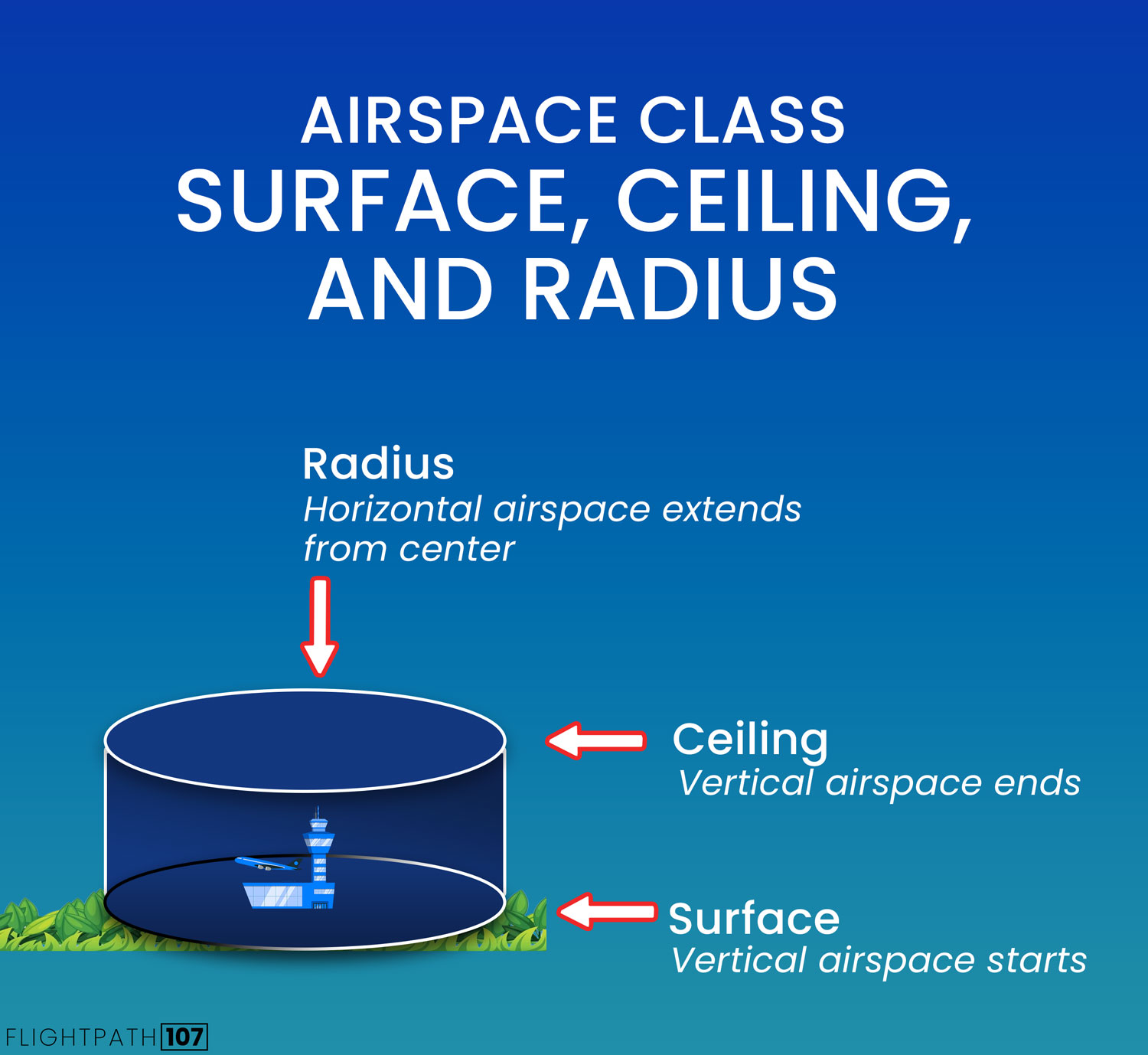
This section focuses on the surface and ceiling limits of G, E, and D airspace class—meaning where the airspace begins and ends vertically.

  • The surface is the starting point of the airspace layer (which isn’t always the ground).
  • The ceiling is the top of that airspace layer, where it transitions into the next class above.

Understanding these vertical boundaries helps you know exactly when you’re entering controlled airspace—and whether clearance is needed.
Class G

Class G airspace always starts at the surface—it’s the ground-level airspace by default.

  • Surface:
    • Class G airspace always starts at ground level.
    • It is the lowest-level airspace by default.
  • Ceiling:
    • Its ceiling (or upper limit) is usually either 700 feet AGL or 1,200 feet AGL, depending on the area.
    • Above that, it transitions into Class E airspace.

Class E

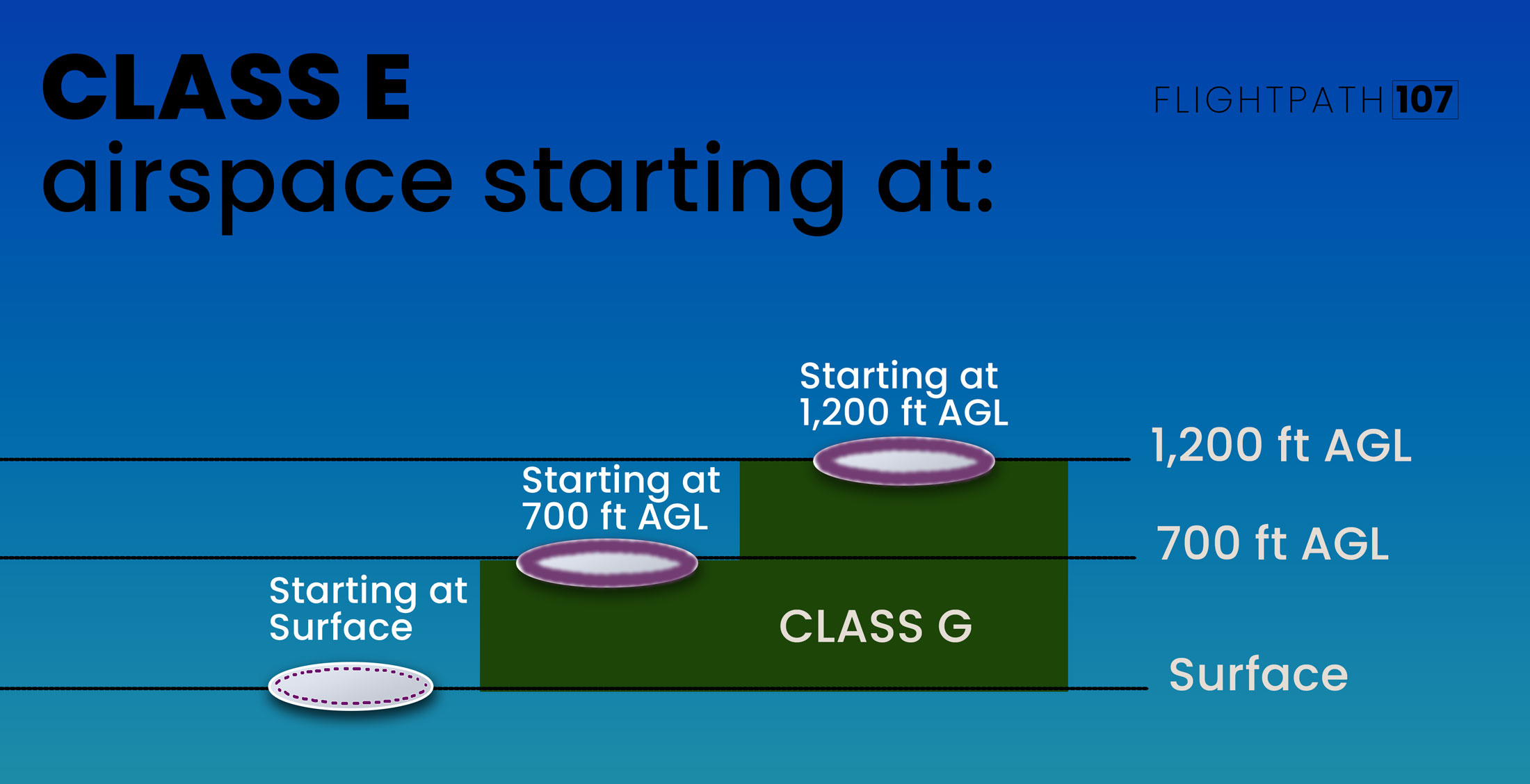
Can start at the surface, 700 feet AGL, or 1,200 feet AGL,
depending on the location.

Surface:
The surface starting point varies based on how much control is needed near airports or populated areas.

  • Surface level (0 ft AGL) – This occurs near airports that need controlled Class E airspace at ground level.
  • 700 feet AGL – commonly found around regional or municipal airports.
  • 1,200 feet AGL – typically in remote areas, away from airports or busy traffic zones.

Ceiling:

  • Class E ceiling goes up to but does not include 18,000 feet MSL, where Class A begins.

The visual aid below shows the three possible starting points for Class E airspace:
Class D

Always surface always starts at ground-level, and typically has a ceiling of 2,500 feet AGL

Surface:
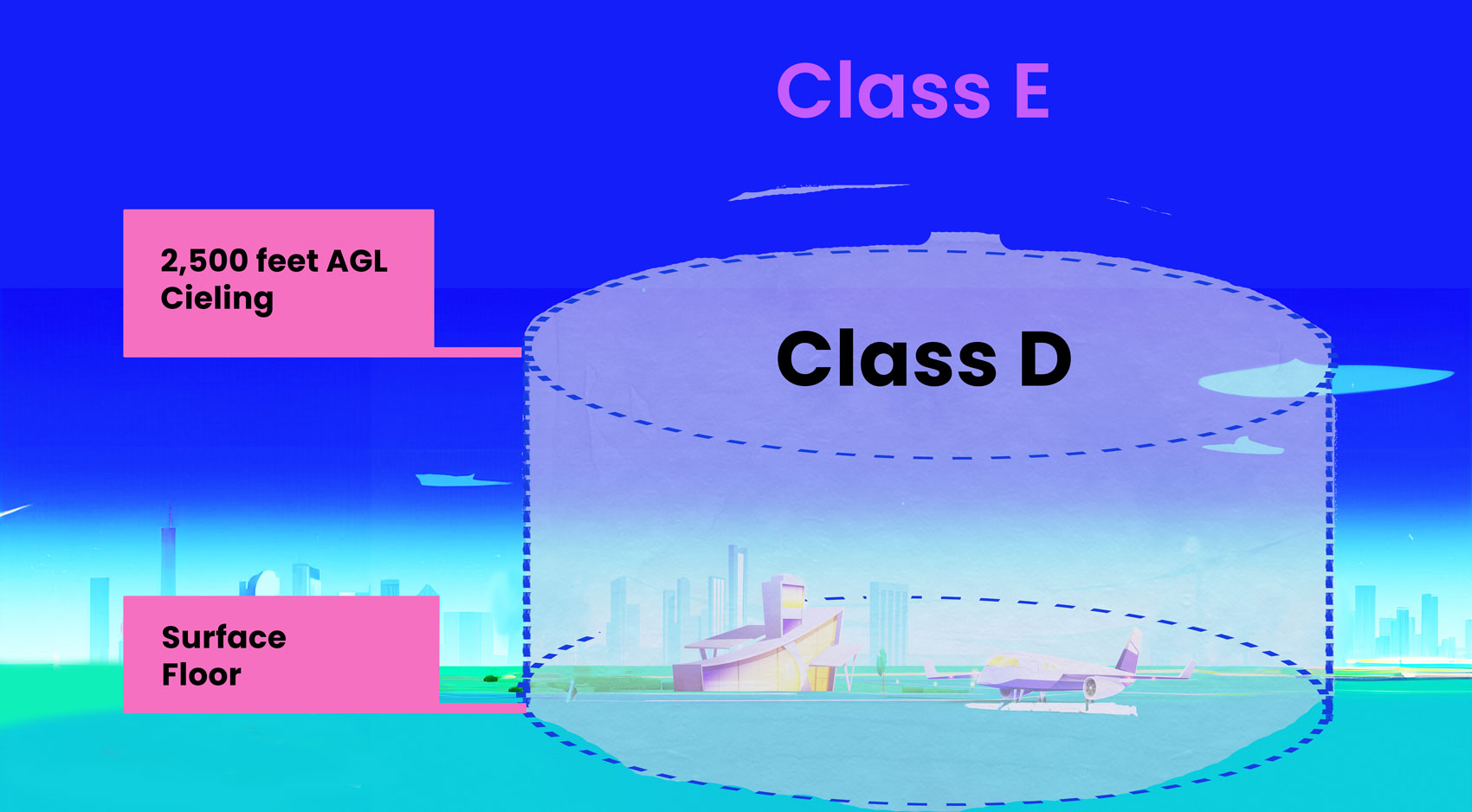
  • Class D airspace surface always starts at ground-level, and typically has a ceiling of 2,500 feet AGL.

Ceiling:

  • Class D ceiling is at 2,500 feet AGL, above which it transitions to Class E Airspace.

The visual aid below shows how Class D airspace surface begins at ground-level, and forms a column that extends upward to a ceiling of 2,500 feet AGL.
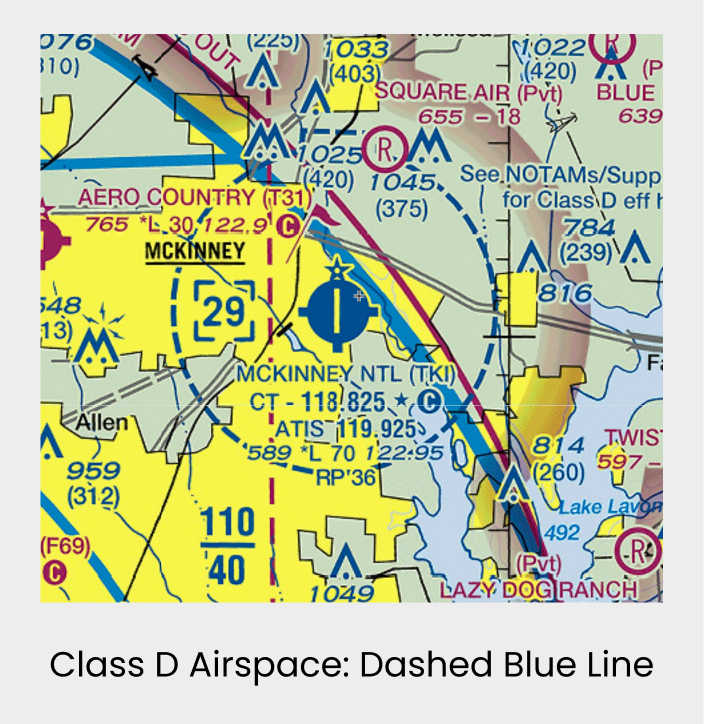
Class D on Sectional Charts

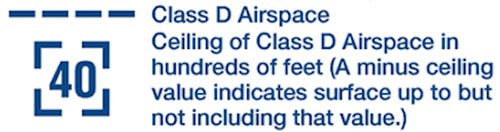
Class D airspace is depicted on sectional charts with a blue dashed line. It typically has a cylindrical shape around the airport, but the exact boundaries are tailored to the airport’s operational needs.
Class E on Sectional Charts

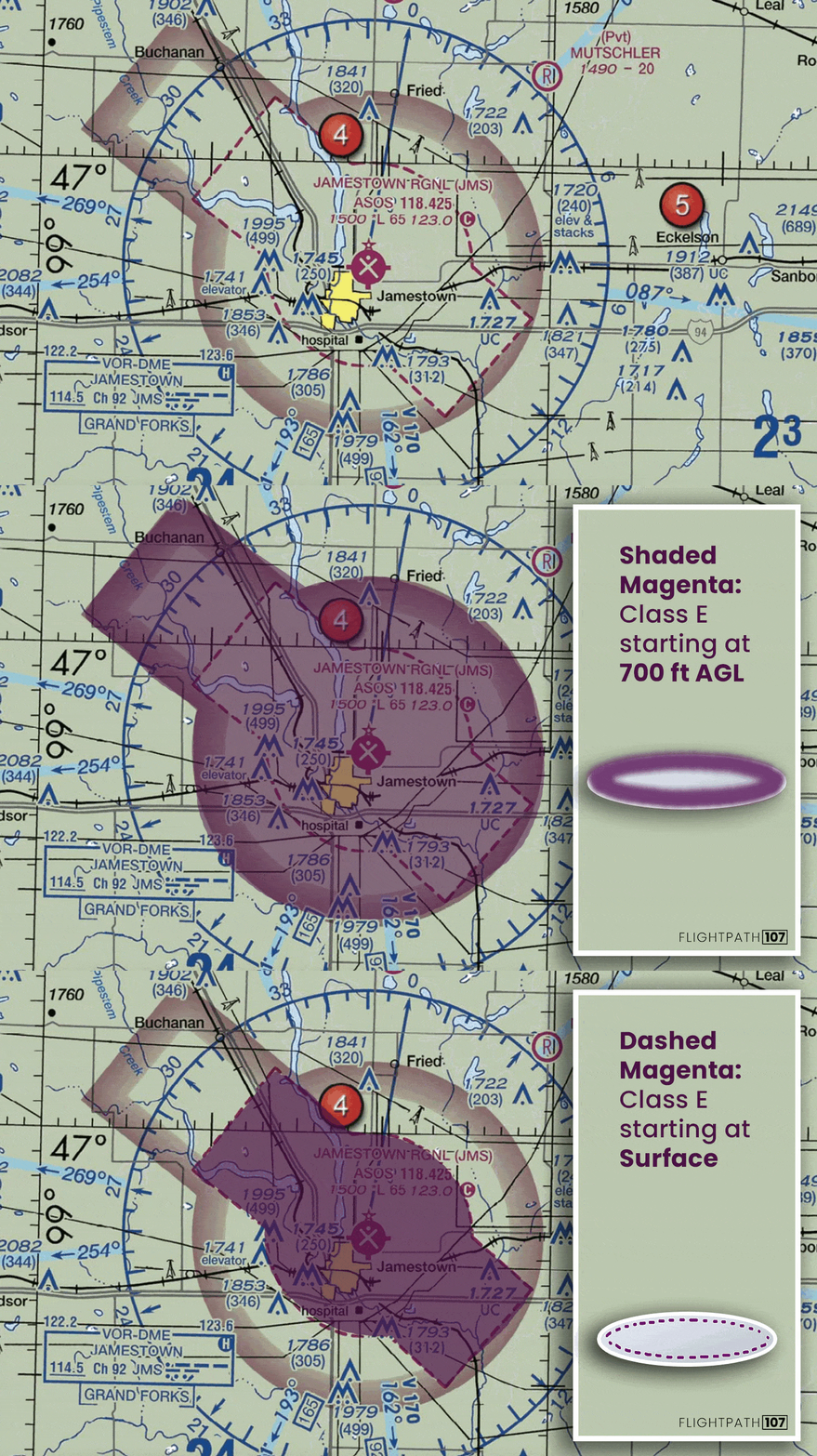
Below is Jamestown Regional Airport (JMS) is situated within two types of Class E airspace.

The area closest to the airport is marked by a dashed magenta line, indicating that Class E airspace starts at the surface and extends up to 700 feet AGL.

Farther out, the shaded magenta line marks where Class E airspace begins at 700 feet AGL.

CHANGE GIF ORDER SO THAT IT’S 1: PLAIN SECTIONAL CHART 2. STARTING AT SURFACE THEN 3. STARTING AT 700 AGL
Practice question (Finish this – do one for each one)

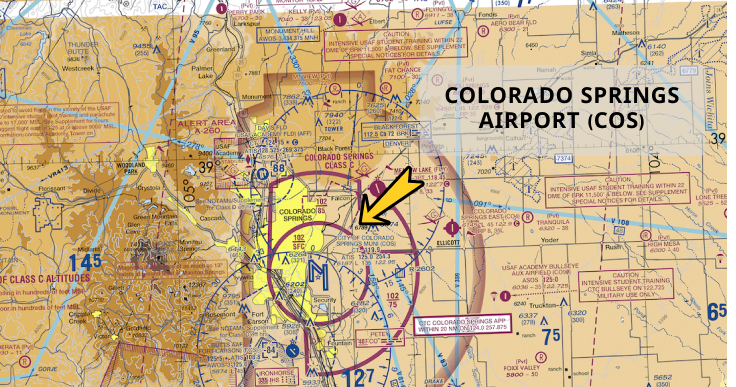
The Colorado Springs Airport (COS) is in what type of airspace?

It is in Class E airspace – dashed magenta line

PRACTICE QUESTION

A blue segmented circle on a Sectional Chart represents which class airspace?

Class D

Class D is always depicted by a blue dashed (segmented) circle. This can also be found in the Sectional Chart legend, as seen below.

According to 14 CFR part 107, how may a remote pilot operate an unmanned aircraft in class C airspace?

A. The remote pilot must have prior authorization from the Air Traffic Control (ATC) facility having jurisdiction over that airspace.

B. The remote pilot must monitor the Air Traffic Control (ATC) frequency from launch to recovery.

C. The remote pilot must contact the Air Traffic Control (ATC) facility after launching the unmanned aircraft

Correct Answer: A – The remote pilot must have prior authorization from the Air Traffic Control (ATC) facility having jurisdiction over that airspace.

Description: You will need an airspace waiver. “No person may operate a small unmanned aircraft in Class B, Class C, or Class D airspace or within the lateral boundaries of the surface area of Class E airspace designated for an airport unless that person has prior authorization from Air Traffic Control (ATC).”

Click image to expand

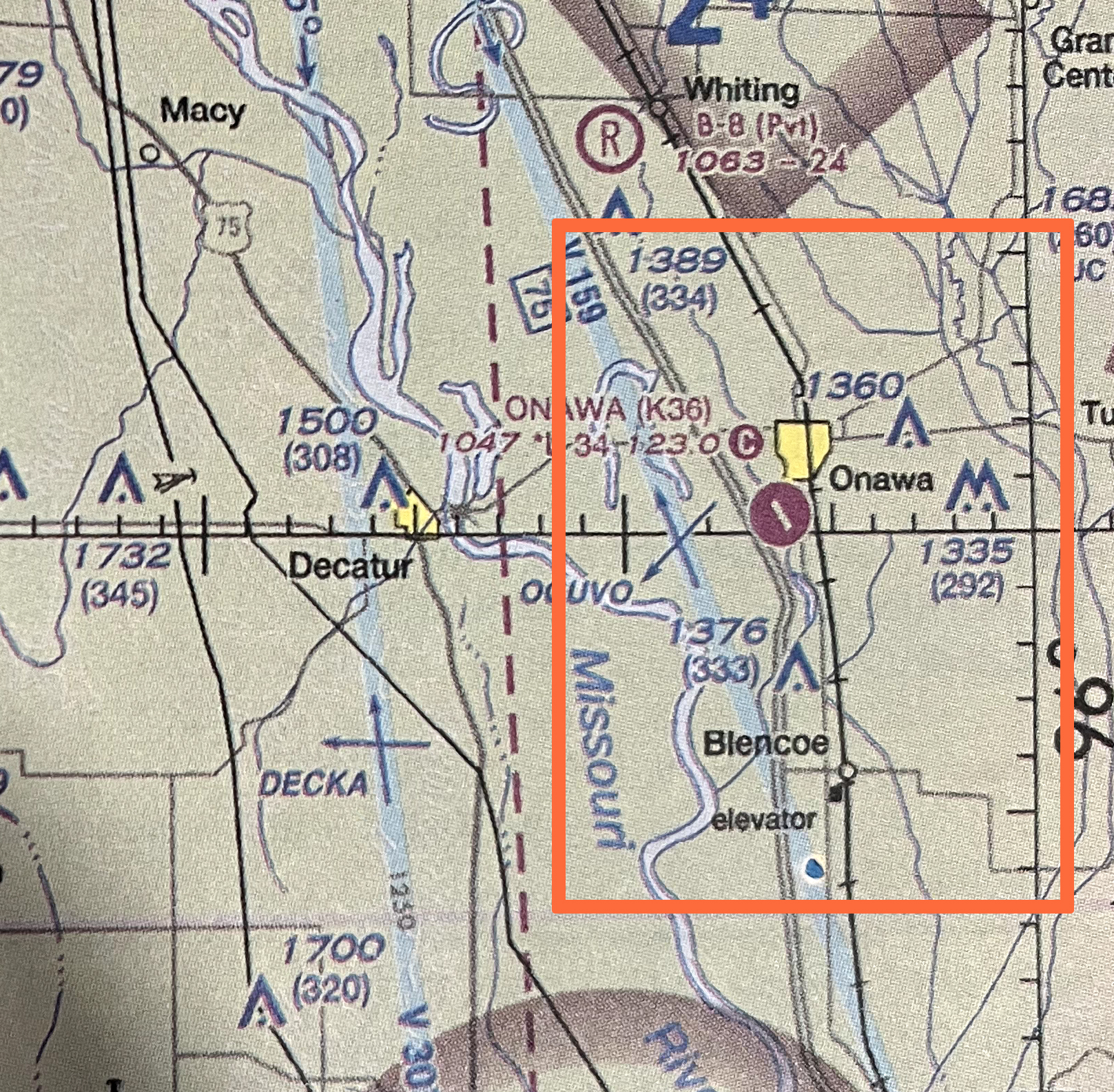
(Refer to figure 78) You have been hired to use your small UAS to inspect the railroad tracks from Blencoe (SE of Sioux City) to Onawa. Will ATC authorization be required?

A. Yes, Onawa is in Class D airspace that is designated for an airport.

B. No, your entire flight is in Class G airspace.

C. Yes, you must contact the Onawa control tower to operate within 5 miles of the airport.

Correct Answer: B – No, your entire flight is in Class G airspace.

Description:
In this scenario, ATC (Air Traffic Control) authorization will not be required for the small sUAS inspection of the railroad tracks from Blencoe to Onawa.

The reason is that the entire flight is planned within Class G airspace, which is uncontrolled airspace.

Class G airspace typically extends from the surface to a specified altitude, and in this context, it allows for unmanned aircraft operations without the need for specific ATC authorization.

Operating within Class G airspace simplifies the regulatory requirements for the flight, and as such, ATC authorization is not necessary for this particular mission.

Click image to expand

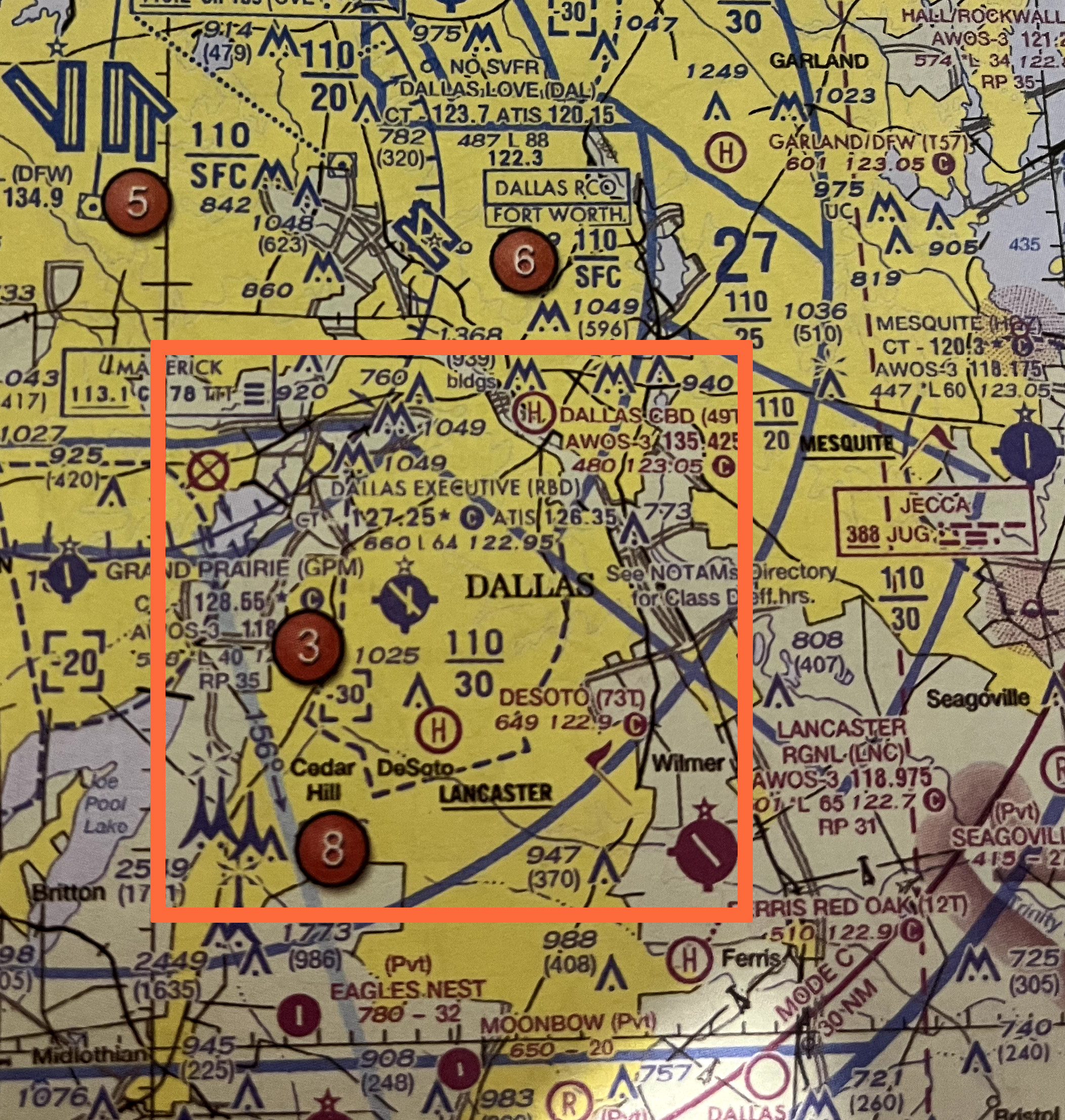
(Refer to Figure 25, Area 3.) The floor of Class B airspace at Dallas Executive (RBD) is

A. 3,000 feet MSL.

B. at the surface.

C. 3,100 feet MSL

Correct Answer: A. 3,000 feet MSL.

Description:
Look for the fraction in the outer shelf area of Savannah’s airspace. You’ll notice it says 41/13, indicating the ceiling (41) and floor (13) of this Class C airspace in that part of the chart. Remember, they cut two 0s off, so this means 4,100 feet MSL, and 1,300 feet MSL.

We know this is not AGL because AGL is always listed in parentheses.

The 41/13 means that in this specific part of the chart, the ceiling of the Class C airspace is 41,000 feet MSL, and the floor is 1,300 feet MSL.

Click image to expand

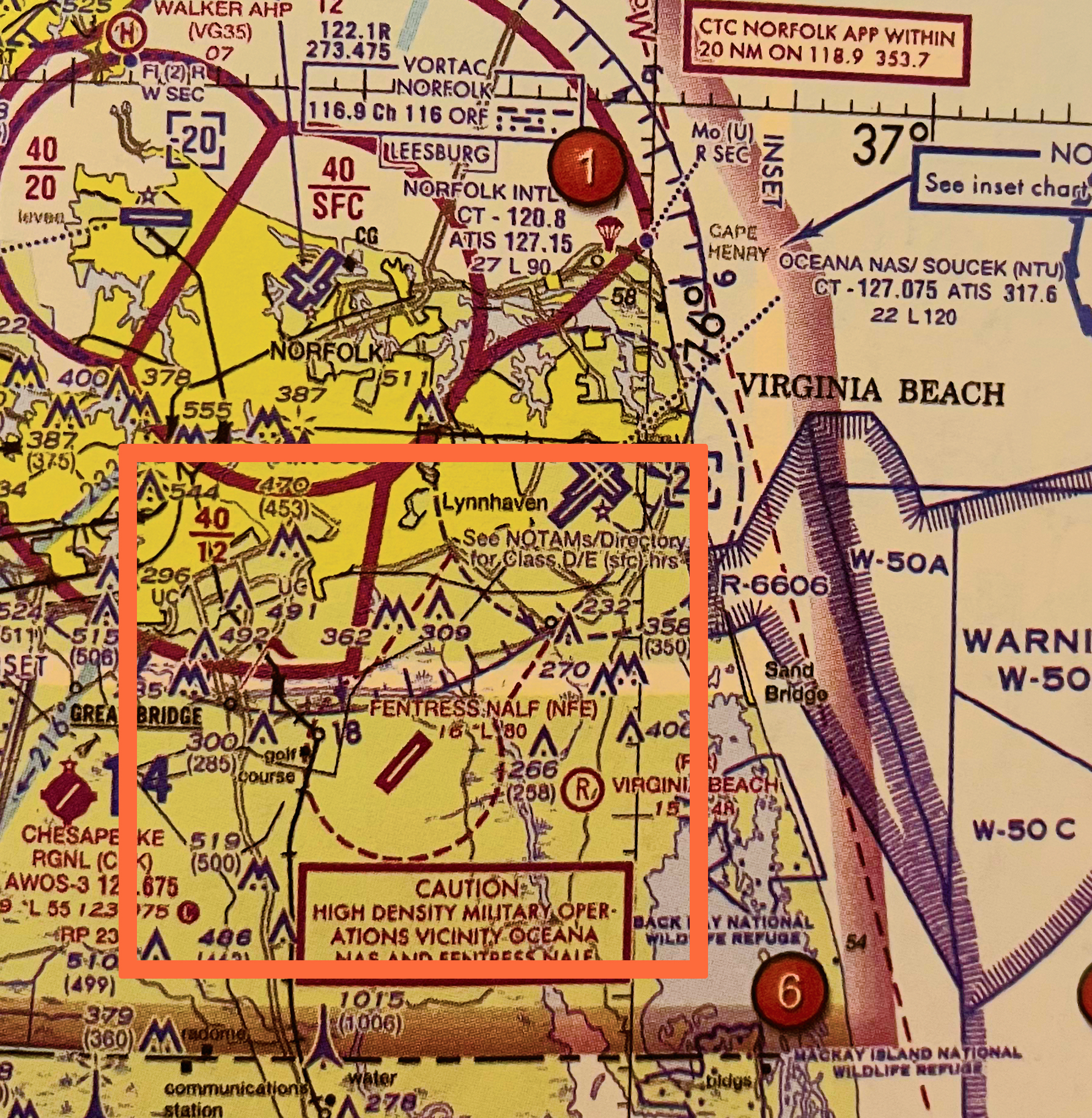
(Refer to Figure 20, Area 1.) The Fentress NALF Airport (NFE) is in what type of airspace?

A. Class E.

B. Class G

C. Class C.

Correct Answer: A. Class E.

Description:
You can identify this by observing the dashed magenta line, indicating the presence of Class E airspace at the surface.

According to 14 CFR part 107 the remote pilot in command (PIC) of a small unmanned aircraft planning to operate within Class C airspace

A. must use a visual observer.

B. is required to receive ATC authorization.

C. is required to file a flight plan.

Correct Answer: B. is required to receive ATC authorization

Description:

Why A&B are not the answers:
A. Using a visual observer (VO) is not a universal requirement for all operations within Class C airspace under Part 107.

B. Filing a flight plan is not a requirement for small unmanned aircraft operations within Class C airspace under Part 107. While the PIC should be aware of and follow any local procedures, the specific requirement is to obtain ATC authorization.

Practice Quiz

Airspace Classes D, E, G

1 / 12

How is Class D airspace depicted on sectional charts?

2 / 12

What is typically the ceiling of Class D airspace?

3 / 12

What happens to Class D airspace when the control tower is closed (such as during nighttime operations or off-hours)?

4 / 12

Is specialized equipment, like an ADS-B transponder, mandatory in Class D airspace?

5 / 12

What type of communication is required before entering Class D airspace?

6 / 12

What is required for flying in Class E airspace?

7 / 12

How is Class E airspace that starts at the surface depicted on sectional charts?

8 / 12

How is Class E airspace that starts at the 700 ft AGL depicted on sectional charts?

9 / 12

What is true about communication requirements in Class G airspace?

10 / 12

What is a characteristic of Class G airspace?

11 / 12

What specialized equipment is required for operations in Class G airspace?

12 / 12

What happens when Class G airspace transitions as you go higher?

Your score is

The average score is 74%

0%