
What is an Airspace Class?
If you’ve never heard of “airspace classes,” think of the sky sectioned off into different layers or zones.
Each layer is managed differently based on how busy it is, how close it is to airports, and how much control the FAA needs to keep everyone safe.
These layers are called airspace classes—and they help organize where different types of aircraft can fly and under what rules.
For drone pilots, knowing which class you’re flying in is very important. Some areas require air traffic control permission, while others don’t. Some are full of fast-moving planes, others are quieter. Some require specific equipment to fly your drone within that airspace class, and others don’t.
If you fly your drone in airspace that requires authorization, you could get into some pretty serious trouble with the FAA, be fined quite a lot of money, loose your drone flying privileges, and put other pilots and individual in danger.
So before you launch, it’s important to know which slice of sky you’re in.
The 5 Official Airspace Classes of the USA
Airspace classes around airports are generally organized by how busy and regulated they are.
Starting with Class G, which is the least regulated and most common type of airspace across the U.S., each class becomes progressively more controlled and restricted, leading up to Class B, which surrounds the busiest and most tightly regulated airports.
Note: Class A airspace starts at 18,000 feet MSL—well above the altitude limits for drone operations—so it’s not included in this overview.
Here’s a breakdown of class B, C, D, E, and G, from the most to the least controlled,:
Class G Airspace
- Covers most of the U.S. at ground level, especially in less developed areas
- Example airport: Hagerstown Regional Airport (HGR)

Class E Airspace
- Small airports, especially in less busy or rural areas.
- Example airports: Aspen County Airport, CO (ASE)

Class D Airspace
- Airspaces surrounding smaller airports compared to the size of class B and C. Many municipal airports fall into Class D.
- Example airport: Santa Monica Municipal Airport (SMO)

Class C Airspace
- Typically around mid-sized airports.
- Example airport: Nashville International Airport (BNA)

Class B Airspace
- Found around major, busy airports.
- Example airport: Los Angeles International Airport (LAX)

Airspace Class Regulation Distinctions
As we explore the different airspace classes, there are a few key distinctions you’ll want to keep in mind. These will help you understand where you can fly, what permissions or equipment you might need, and how to stay compliant:
- Control Tower Presence – Is the airspace controlled or uncontrolled with a tower present?
- ATC Authorization Requirement – Do you need ATC clearance to enter the airspace class?
- Specialized Equipment – Are you required to have ADS-B, transponders, or other tech?
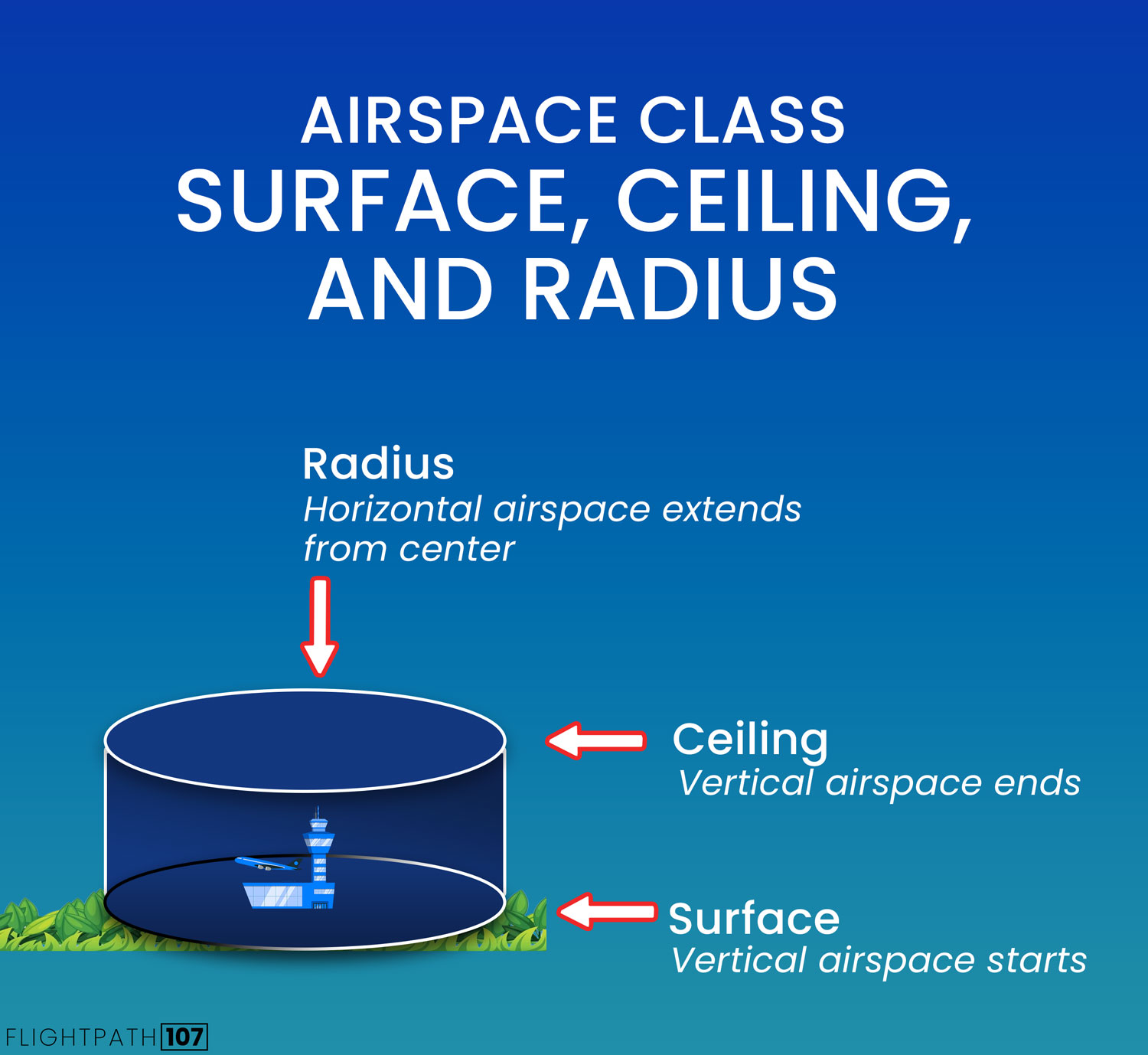
- Airspace Surface and Ceiling – How high and wide does the airspace extend before it transitions into another class?
Detailed Breakout

1. Control Tower Presence
Controlled Airspace (Towered)
- Controlled airspace is regulated by ATC, meaning you must get airspace authorization before entering, including as a drone pilot.
Uncontrolled Airspace (Untowered)
- Uncontrolled airspace does not have ATC supervision, which means you don’t need prior permission to fly there. This is typically the case for more rural or less densely populated areas. In these areas, drones can be flown without needing to request clearance from ATC.

ATC Authorization Requirement
In certain airspace classes, especially around busy airports or in controlled areas, you’ll be required to have a permission from Air Traffic Control (ATC) to fly in the airspace. ATC gives clearance to enter, instructions during your flight, and facilitates safe separation from other aircraft.
In less regulated, uncontrolled airspace, like Class G, you won’t need ATC permission because there’s no ATC oversight.
Specialized Equipment
In some airspaces, manned aircraft are required to have specific equipment:
- Mode C transponder – sends the aircraft’s ID to Air Traffic Control
- ADS-B Out – broadcasts the aircraft’s altitude and position
- Altimeter – measures altitude
These systems are primarily for larger, manned aircraft or certain situations, and most recreational or commercial drones flying under typical conditions don’t need them.

Airspace Surface and Ceiling
One of the key differences between airspace classes is how they’re shaped vertically and horizontally.
Each class has a defined surface (where it begins), a ceiling (where it ends), and a radius (how far it spreads out horizontally from a central point).
Below is a mock airspace example to help visualize how surface, ceiling, and radius define the shape and boundaries of each airspace class.