Defining US Airspace Classes
Introduction
The FAA organizes airspace into classes labeled A through G (A, B, C, D E, F G). Each of these classes have their own specific flight access rules, generally organized by how busy and regulated they are.
Think of it as a zoning system for the sky. Just like a city separates residential neighborhoods from commercial districts and industrial zones, the FAA separates airspace around busy international airports from small regional ones, from open rural skies, from the surface up to the stratosphere.
As a Part 107 remote pilot, these classes matter to you because where you can fly, and how you fly there, depends entirely on which class you’re operating in.
Each class has a shape:
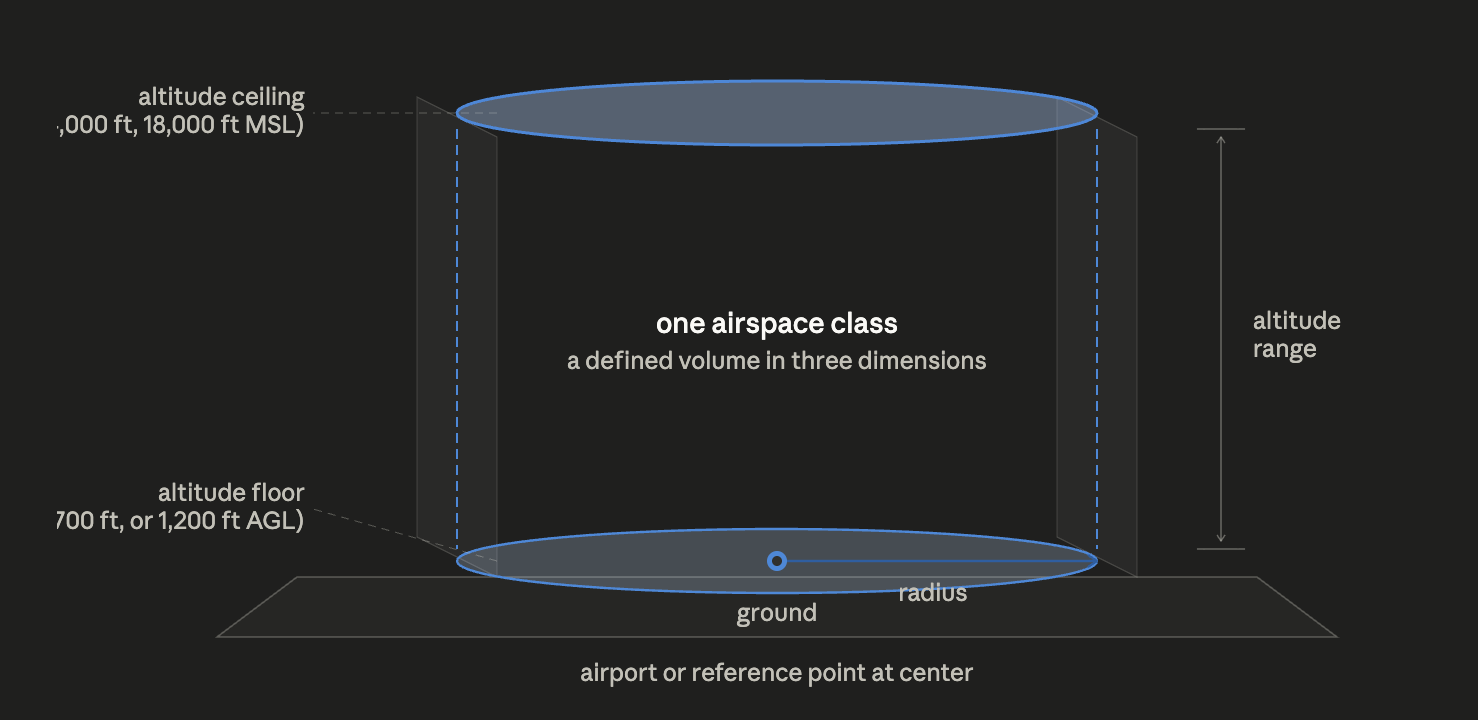
Airspace isn’t just a flat line on a map. Every class of airspace exists in three dimensions. It has a floor a lower altitude boundary), a ceiling (an upper altitude boundary), and a horizontal footprint (extends outward from a central point, usually an airport).
Some classes start right at the ground. Others don’t begin until 1,200 feet above it for example. Some are narrow cones hugging a small airport. Others are layered cylinders covering a major city’s entire region. And others are simply what’s left over — the uncontrolled airspace that fills the gaps where no other class has been defined.
–
The diagram below shows the basic anatomy of an defined airspace layer. Everything within the 3 dimensional cylinder would be considered to be in that airspace class.
Official Airspace Classes of the USA (B, C, D, E, and G)
Airspace classes around airports are generally organized by how busy and regulated they are. Starting with Class G, the least regulated and most common across the country, each class becomes progressively more controlled, leading up to Class B, which surrounds the nation’s busiest airports.
Not every class works the same way or is facilitated by the same regulations.
- Airport-Anchored Airspace (B, C, and D): These 3 classes are tightly tied to specific airports. Think of them as bubbles of regulated airspace centered on a facility. Class B, C and D are anchored to an airport.
- Environmental Airspace (E and G): These two classes different. Rather than belonging to any one airport, they make up most of the airspace aircraft travel through between destinations. They’re the atmosphere that fills the gaps, covers rural areas, and wraps around the defined airspace classes like B, C, and D. Class E and G can be seen as environmental. Think of them as “the atmosphere between and around airports.”
With that framework in mind, let’s look at each class on its own.
Airport-Anchored Airspace:
Tied to specific airports
Class B
Surrounding the busiest major airports
Class B airspace is the busiest and most protected airspace in the country.
It is built around major international airports with heavy airline traffic constantly arriving and departing.
Aircraft move through this airspace in highly organized layers controlled closely by Air Traffic Control.
Drone pilots need authorization before flying here because of the large amount of fast-moving commercial aircraft nearby.
- Example Class B Airports:
- Los Angeles International Airport (LAX) is a major international airport with heavy commercial and international traffic. is
- Denver International Airport (DEN) is a Class B airspace airport. It serves as a major hub and is surrounded by strictly controlled Class B
Class C
Surrounding medium-to-large airports
Busy controlled airspace surrounding medium-to-large airports that regularly handle commercial traffic.
While not as intense as Class B, there is still a constant flow of arriving and departing aircraft, including passenger jets, private aircraft, and helicopters.
Drone pilots need authorization because aircraft activity is still significant and often occurs at lower altitudes near the airport.
- Example airport: Nashville International Airport (BNA)
Class D
Surrounding smaller towered airports
Controlled airspace surrounding smaller towered airports.
These airports still have regular aircraft activity and Air Traffic Control, but traffic levels are usually lighter and slower paced compared to Class B and C airports.
Drone pilots should remain especially aware of low-flying aircraft entering and leaving the airport environment.
- Example airport: Santa Monica Municipal Airport (SMO)
Environmental Airspace:
The atmosphere between and around airports.
Class E
The controlled airspace filling the gaps between the more structured airport airspaces. Class E is not an airport-centered system like B, C, or D.
Class E does not have a clearly defined shape on sectional charts like Class B, C, or D airspace.
Aircraft commonly travel through Class E while flying across the country, climbing, or descending between destinations.craft can still move through these areas quickly and from many directions.
- Example: Aspen, Colorado has Class E surface airspace
Class G
Class G is not an airport-centered system like B, C, or D. It’s more the surrounding uncontrolled airspace commonly found in rural or less congested areas.
Pilots are responsible for seeing and avoiding each other while operating here. Class G.
Class G airspace is commonly found in rural areas, open countryside, and lower-altitude areas away from larger airports.
Even though it is uncontrolled, aircraft such as crop dusters, helicopters, training aircraft, and small planes may still operate at very low altitudes.
- Example airport: Hagerstown Regional Airport (HGR)