Why it Matters for Flying
In The Field
Fieldwork Foundations
Picture this: You’re flying your drone early in the morning in the desert. Cool air, smooth flight, great battery performance. By mid-afternoon, you return to fly the exact same route. But this time, your drone’s battery drains fast, the motors sound strained, and it struggles to gain altitude. Same place, same altitude, but the air feels thinner.
That’s density altitude at work.
While the ground elevation hasn’t changed, the air density has. As temperatures rise or humidity increases, the air becomes thinner—meaning your drone has to work harder to stay aloft. And in high-elevation places like the Rockies or hot cities in summer, this effect is magnified.
Understanding density altitude is key for any pilot who wants to avoid sudden performance drops, shorter flights, or mid-air instability.
Lesson Focus
How Density Altitude Affects Drone Performance
In this lesson, you’ll learn what density altitude is, what factors influence it, and how it impacts your drone’s lift, efficiency, and battery life. We’ll break down the roles of temperature, pressure, and humidity.
Temperature, altitude, and humidity all affect density altitude—when any of them increase, so does the density altitude.
Knowing the density altitude helps you predict how your drone will handle in different environments.
- High elevation areas (like Colorado)
- Hot summer days
- Humid or low-pressure environments
All of these increase density altitude and make safe, smooth flying more difficult.
Defining Density Altitude
The Altitude the Air Feels Like
Weather Foundations
When pilots talk about density altitude, they’re talking about how the air feels to the aircraft—not just how high it is above the ground. Why? Because higher elevations naturally have thinner air—fewer air molecules in a given space.
So, if you’re flying somewhere hot and humid at sea level, your drone might perform as if it were already up in the mountains. That’s what we mean when we say, “the air is acting like it’s at a higher altitude.”
This matters because thin air = less lift and more battery drain. It’s like your drone thinks it’s climbing a hill, even if you’re standing on flat ground.
Density Altitude is a Calculated Number
Weather Foundations
Density altitude isn’t something you can see with your eyes — it’s a calculated number that tells you how “thick” or “thin” the air is, based on a combination of temperature, pressure altitude, and humidity.
It’s measured in feet and tells you what altitude the air is acting like, regardless of your actual elevation.
For example:
- If you’re at sea level on a hot, humid day, your density altitude might be 3,000 feet — because the air is behaving like it would at 3,000 feet on a standard day.
- If you’re flying in the mountains on a cool, dry day, your density altitude might be lower than your actual elevation — because the air is denser and easier to fly in.
Pilots (including drone pilots) use this number to estimate how well their aircraft will perform in the current atmospheric conditions.
How Air Molecules Affect Flight
How Air Molecules Affect Flight
Weather Foundations
(Note: You won’t be tested on how air molecules work, but we’re taking a moment to explain it so the rest of the lesson makes more sense.)
Air isn’t empty—it’s full of tiny, invisible particles called molecules, mostly nitrogen and oxygen.
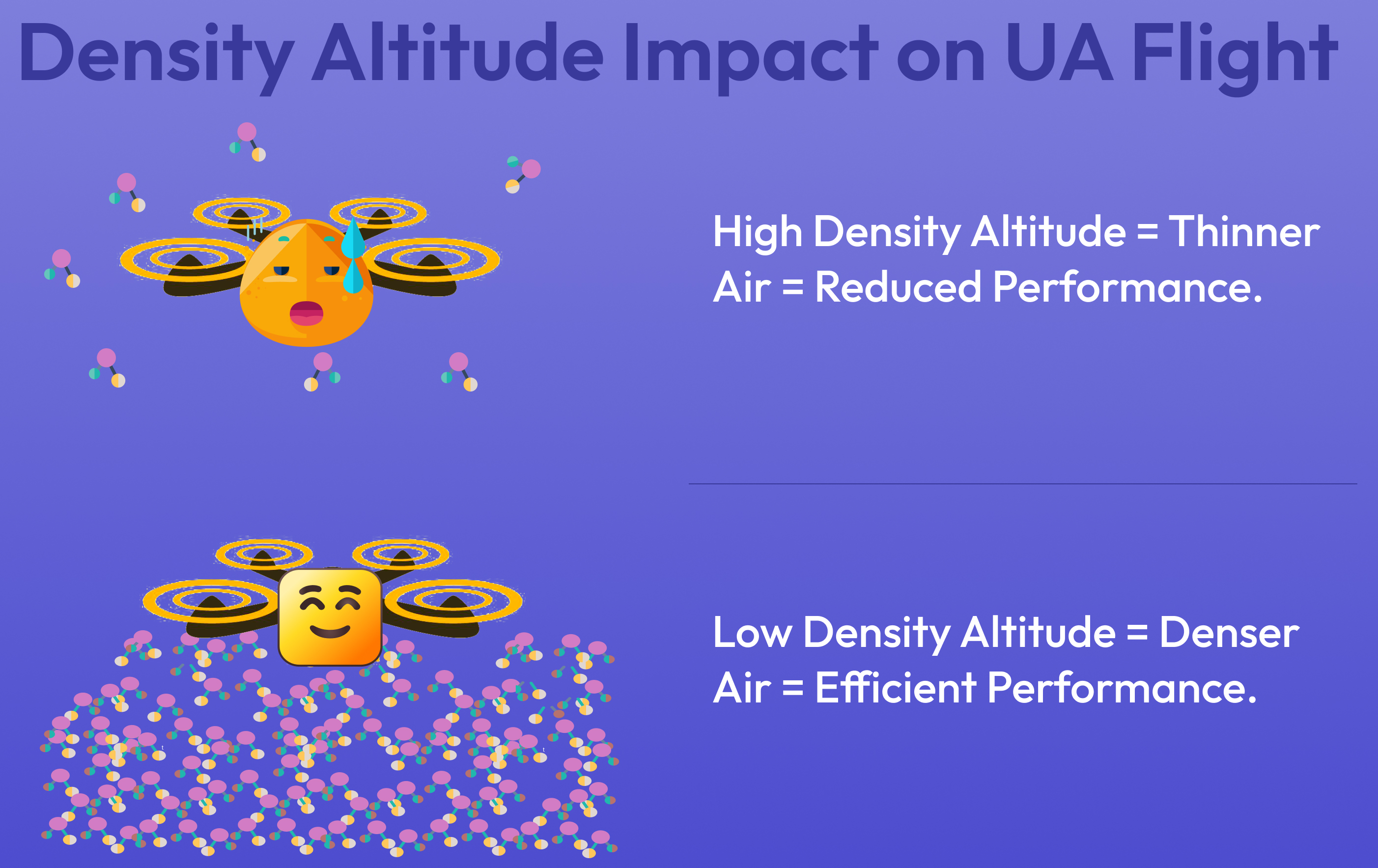
These molecules are what your drone’s propellers push against to stay in the air. The more tightly packed those molecules are, the easier it is for your drone to generate lift and fly efficiently.
- When air molecules spread out, the air becomes “thin.” That means your drone has less to push against, so it has to work harder—draining the battery faster and reducing lift.
- When the molecules are closer together, the air becomes “thick,” giving your drone more to grip onto and helping it fly more efficiently.
Put Simply:
- Denser air (molecules close together) = provides more lift for your propellers.
- Thinner air (molecule s spread apart) = creates harder work for your drone.
What Impacts These Molecules
Several atmospheric factors can cause these molecules to spread out, making the air thinner and less supportive for flight:
- Temperature: Heat energizes the molecules, causing them to move faster and spread apart.
- Pressure altitude: Increase in pressure altitude causes air pressure drops—causing molecules to be more widely spaced.
- Humidity: Adds water vapor to the air, displacing heavier oxygen and nitrogen molecules with lighter water molecules.
Next we are going to look at each of these more closely, in relation to what is known as a “Standard Day” in aviation, as well as how each one impacts the measured Density Altitude in any given moment.
Next we are going to look at each of these more closely, in relation to what is known as a “Standard Day” in aviation, as well as how each one impacts the measured Density Altitude in any given moment.
Defining the “Standard Day”
A Baseline for Comparing Weather Conditions
Weather Foundations
Now that we understand how temperature, pressure altitude, and humidity can change the way air behaves, there’s one more piece to cover: the Standard Day.
In aviation, the Standard Day is a fixed reference point—essentially a set of “ideal” atmospheric conditions at sea level. It gives us a way to compare real-world conditions against a known baseline.
By knowing what’s standard, we can measure how far today’s weather deviates from a true standard day’s conditions —and how that will affect flight performance.
Why Is the Standard Day Based at Sea Level?
Weather Foundations
Sea level is used as the reference point because it’s the starting line for atmospheric measurements. At sea level, air pressure is at its highest, and conditions are the most stable and predictable. From there, we know that as you go higher in altitude, the air becomes thinner and pressure decreases.
By defining standard values at sea level, aviation has a universal baseline to compare against.
Think of it like using a ruler that starts at 0. Sea level is where we start measuring the atmosphere, just like how a ruler starts at the beginning so you can see how far something goes from there.
What are the 3 Parameters for a “Standard Day”?
When we say “standard day,” we are referring to the following specific parameters:
- Pressure: 29.92 inches of mercury (inHg) or 1013.25 millibars
- Temperature: 15°C (59°F)
- Humidity: 0% (completely dry air)
It’s like saying, “This is what normal feels like. Anything different? Expect things to fly a little differently.”
Let’s take a closer look at each one, and how they can impact drone flight:
What are the 3 Parameters for a “Standard Day”?
Weather Foundations
When we say “standard day,” we are referring to the following specific parameters:
- Pressure: 29.92 inches of mercury (inHg) or 1013.25 millibars
- Temperature: 15°C (59°F)
- Humidity: 0% (completely dry air)
It’s like saying, “This is what normal feels like. Anything different? Expect things to fly a little differently.”
Let’s take a closer look at each one, and how they can impact drone flight:
1. Pressure Altitude
29.92 inches of mercury (inHg) or 1013.25 millibars
When we say the standard pressure at sea level is 29.92 inches of mercury (or 1013.25 millibars), we mean:
That’s how much the air usually pushes down on us at sea level on a nice, average weather day.
- Imagine a big invisible blanket of air covering the Earth. That air has weight, and it presses down on everything—including us, as well as your drone.
- Scientists figured out that on a normal day at the beach (which is sea level), the air pushes down with just the right amount of force to push mercury up a tube to 29.92 inches in a barometer, which is the instrument that measures air pressure.
- We also have another unit called millibars, and 1013.25 mb is the same thing—just in different units, like inches vs. centimeters.
This “standard” pressure gives pilots a baseline to compare with. So if the pressure is lower, it means the air is thinner—and your drone might have a harder time flying.
Pressure Altitude Impact on Flight:
If the current atmospheric pressure is lower than 29.92 inHg, that means you’re in thinner air — either because you’re physically at a higher altitude or because the weather system is causing low pressure.
That low pressure = higher pressure altitude, which means:
- Fewer air molecules
- Less lift
- Less efficient propeller performance
2. Temperature
15°C (59°F)
When we say the standard temperature at sea level is 15°C (59°F), we’re talking about what the average air temperature is expected to be on a calm, normal day at sea level.
- Temperature affects how fast air molecules move. Warmer air means faster-moving molecules that spread out more—making the air “thinner.”
- On a standard day, 15°C (or 59°F) is used as the baseline temperature to compare actual conditions to.
- If the air is hotter than 15°C, the molecules are more spread out, and your drone will have a harder time flying.
- If it’s cooler, the molecules are packed more tightly, and flight becomes more efficient.
This temperature value is part of what pilots use to figure out if the air is going to help or hinder their drone’s performance. Think of 15°C (or 59°F) as the “default temperature” the atmosphere is measured against.
Temperature Impact on Flight:
When the air is hot, its molecules move faster and spread out. That means fewer molecules in a given space—again, thinner air means less efficient flight. On hot days expect shorter flights and slower climbs.
3. Humidity
0% (completely dry air)
When we say the standard humidity is 0%, we mean that on a standard day, the air is assumed to be completely dry—no water vapor in it at all. That gives us a clear baseline to compare against when moisture is present.
- Humidity is the amount of water vapor in the air.
- Water vapor is made of lighter molecules than oxygen and nitrogen (the usual stuff in air). So when humidity goes up, those heavier air molecules get replaced with lighter water vapor.
- This makes the air less dense—which means your drone’s propellers have less to push against.
On a standard day, we assume 0% humidity so the air is at its densest for calculations. That way, when humidity rises, we know the air is getting thinner than that standard, and drone performance will likely go down.
Humidity Impact on Flight:
It might seem backwards, but moist air is actually lighter than dry air. That’s because water vapor molecules weigh less than oxygen and nitrogen. High humidity displaces heavier air particles. Less dense air means propellers have less to grab onto.
On a humid, tropical day—even if you’re at sea level—your drone will still have to work harder to generate lift.
Putting It All Together:
High vs. Low Density Altitude
Now Let’s Bring It Back to Density Altitude
Weather Foundations
Now that you understand how air molecules behave—and how temperature, pressure altitude, and humidity shift those molecules around—it’s time to bring it all back to the big picture: density altitude.
- Density altitude is a numerical value, measured in feet, that tells you what altitude the air is behaving like based on current atmospheric conditions.
It’s not just a feeling—it’s a calculated comparison to the Standard Day (15°C, 29.92 inHg, 0% humidity at sea level).
✱ Important to Know: At these exact standard conditions, density altitude equals pressure altitude. If any of those values change (temperature, pressure, or humidity), density altitude will shift away from pressure altitude—and that’s when performance changes begin.
The Two Ends of the Spectrum:
Low Density Altitude (Thick Air)
Optimized Drone Performance
When the air is denser—due to cooler temperatures, lower humidity, and lower altitude pressure—the density altitude decreases. This improves drone performance, as there are more air molecules for the propellers to generate lift, allowing for better efficiency and performance.
- Molecules are tightly packed
- More efficient flight
- Drone feels strong, stable, and responsive
- Common on cool, dry days at lower elevations
High Density Altitude (Thin Air)
Challenging Drone Performance
When the air is less dense—due to factors like warmer temperatures, higher humidity, or higher altitude pressure—the density altitude increases. This makes it harder for drones to perform optimally, reducing their takeoff and climb performance. The drone’s motor has to work harder, using significantly more power to lift off.
- Molecules are spread out
- Propellers have less to push against
- Flight becomes sluggish and power-hungry
- Happens in hot, humid, or high-elevation conditions
Key Distinction:
Let’s separate two important terms:
- Air Density: How tightly packed the air molecules are (high density = more molecules).
- Density Altitude: How high your drone feels like it’s flying based on the air’s density.
So Remember:
- High temp, high humidity, and high pressure altitude = thinner air = higher density altitude = reduced drone performance
- Low temp, low humidity, low pressure altitude = thicker air = lower density altitude = improved drone performance
Flash Cards
Density Altitude
is defined by?Pressure Altitude & Ambient Temperature
High density altitude equals thinner air, making your propellers less efficient.High Density Altitude
Impact on propeller efficiency?Decreased Efficiency
High density altitude equals thinner air, making your propellers less efficient.Hot and Humid Weather
Impact on aircraft performance?Decreased Efficiency
Hot and humid conditions further increase density altitude, worsening performance.
Standard Day
Standard air temperature and pressure at sea level?15º C 29.92” Hg
At these standard conditions, density altitude and pressure altitude will be equal to each other.
Pressure Altitude
If the outside air temperature is *warmer* than standard, the density altitude is?Higher than Pressure Altitude
Density altitude is lower than the pressure altitude because colder air is denser.
Pressure Altitude
If the outside air temperature is *colder* than standard, the density altitude is?Lower than Pressure Altitude
Density altitude is higher than the pressure altitude because warmer air is less dense.